What Really Happens After Your Laundry Is Picked Up
A step-by-step look at the laundry pickup process in Ottawa: how we sort, wash, fold, and return clothes within 48 hours, and how to track each stage.
- Duong Quan Nguyen
- Updated March 19, 2026
- 24 min read
Read the guide
Keep the guide open while the Laundryless route stays clear.
Use the 9 jump links to move through this guides article without losing your place. On wider screens the dispatch rail stays beside the Ottawa laundry guide while the body keeps the original blog typography.
Guides
Quick answer
After pickup, your laundry is weighed on a calibrated scale, sorted by colour and fabric, and washed on its own, never mixed with another household's. It is then dried, folded, and checked before it comes back within 48 hours, and your saved card is charged after delivery.
The bag leaves your door one morning. Within a day or two it is back, folded and ready to shelve. Between those two moments sits a sequence of steps that most customers never see, and that invisibility is exactly what makes a first pickup feel like a small leap of faith. You hand a bag of clothes to someone and trust that the right things happen before it comes back. This post exists to replace that trust-on-faith with trust-on-knowledge by walking you through every stage of the laundry pickup process from the second the driver takes the bag to the second it lands on your doorstep again.
We covered the booking flow in a separate post. That guide ends at the moment you leave the bag for collection. This one starts exactly where that one stops. If you have already booked a pickup or are thinking about your first one, this is what the other side of the door looks like once your laundry is on its way.
Our Ottawa laundry pickup and delivery service returns your laundry within 48 hours of pickup as standard, with an optional 24-hour rush when you need it sooner. That reliable turnaround is not magic and it is not rushed. It is the result of a fixed sequence of stations, each with enough time built in to do the work properly, chained together in a schedule that holds to a dependable window. What follows is that chain, laid out in the open so you can picture exactly where your clothes are at any point during the cycle.
The handoff at pickup
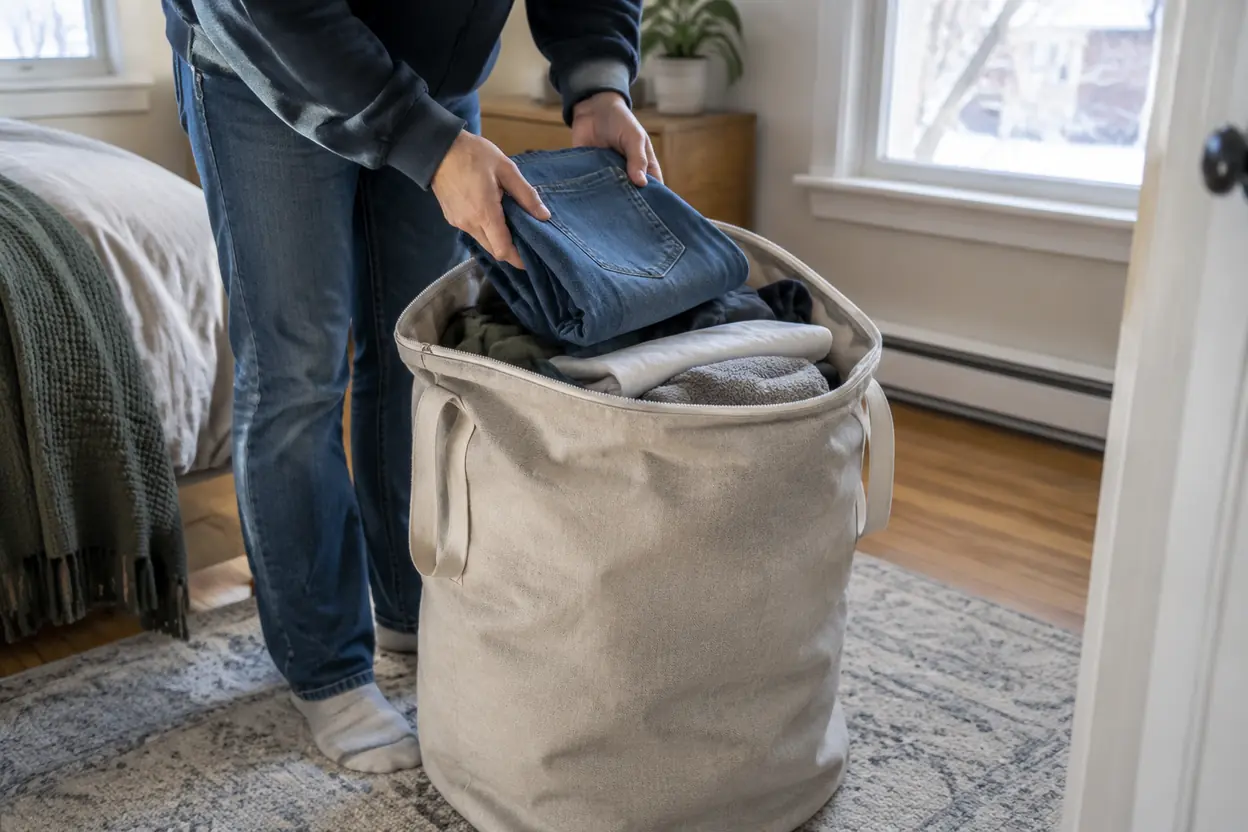
The pickup itself is a two-minute event, but it carries more structure than you might expect from something so brief. When the driver arrives at your door, lobby, or agreed handoff spot, the first action is a photograph of the bag. That photo serves as proof of receipt, timestamped and attached to your order in the system. It confirms the bag was collected, records its condition at the point of handoff, and gives both you and the operation a shared reference if anything needs discussion later.
Once photographed, the bag is scanned into the route system. This scan is what triggers the first status update you will see in the customer app. Within minutes of collection, your order moves from "scheduled" to "picked up," and that status carries the timestamp of the scan so you know the exact minute the bag left your control. There is no lag between the physical event and the digital record. The driver scans, the system updates, you see it.
The driver then places the bag in a dedicated section of the vehicle. Orders are kept separate by household from this point forward, and they remain separated through every subsequent station. Your laundry never touches another customer's laundry at any stage, which is a question people ask often enough that it deserves a clear answer this early in the process.
What happens when something is slightly off at pickup is worth mentioning, because it does occur. If you have left two bags instead of one, both are collected and logged as a single order unless your notes say otherwise. If the bag is heavier than expected, the driver notes the weight estimate but collects it regardless, since final weighing happens at the facility on a proper scale. If for some reason the bag is not where you said it would be, the driver contacts you through the app before leaving the area. None of these are problems. They are small variations that the process is built to absorb without requiring you to do anything extra.
The handoff is also the last moment the bag is in transit without active processing. From this point forward, your laundry is either being worked on or being quality-checked. The drive from your door to the wash facility is the only idle stretch in the entire cycle, and even that is short because the service area is deliberately compact. A tight coverage zone keeps drive times brief, which is what leaves enough time in the turnaround window for every wash, dry, and fold step to happen without rushing.
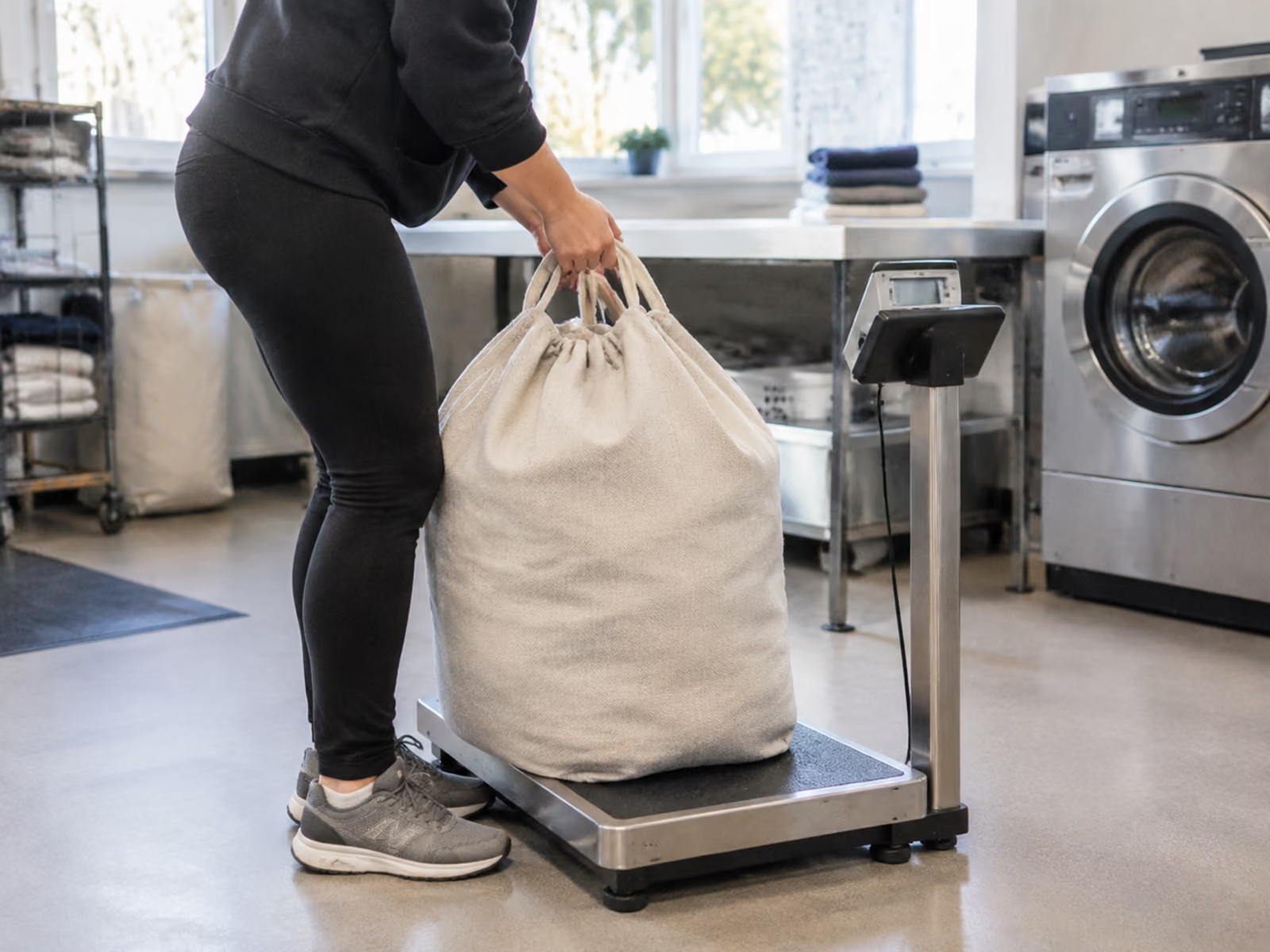
One detail worth understanding before your first pickup: the weight of the bag. At pickup, the driver makes a rough weight note, but the official weigh-in happens on a calibrated scale at the facility. This is the number that determines your invoice, not a guess made curbside. The reason for this separation is accuracy. A bathroom scale or a driver's estimate can swing several pounds in either direction depending on how wet the towels at the bottom are or how tightly packed the bag is. The facility scale removes that variance entirely, and the logged weight is attached to your order record so you can see it in the app alongside the other processing details.
Station timeline from pickup to delivery
The schedule below is a representative run through the stations. Exact times shift slightly depending on route position and load size, but the sequence and the spacing between stations stay consistent. This is what a pickup looks like as it moves through the facility and back to your door within the standard turnaround.
9:00 am
Pickup from your door
Bag is photographed, scanned, and loaded for transport to the facility.
9:30 am
Arrival at the wash facility
Bag enters the facility and is logged into the day queue by order number.
10:00 am
Sorted by colour, fabric, and care notes
Whites, lights, and darks separated. Delicates and special-handling items pulled aside.
10:30 am
Pre-treatments applied
Visible stains are treated before washing. Set-in stains are flagged for your awareness.
11:00 am
Wash cycles start
Loads run on settings matched to the fabric category. Cold water by default.
1:00 pm
Drying with appropriate heat
Heat matched to load type. Cottons get standard heat, synthetics and delicates get low.
2:30 pm
Folding and quality check
Every item folded by hand, checked against a 12-point standard before packaging.
Out for delivery
Loaded for the return route
Finished order loaded for a scheduled delivery run within the turnaround window.
Delivered
Delivered to your door
Clean bag returned to your agreed spot. App updates to delivered with a timestamp.
That is nine discrete events across the standard turnaround window, which means each station has genuine breathing room rather than being crammed into an impossible schedule. The reason the standard turnaround works without cutting corners is that the sequence is designed with slack at the stations that need it most: the wash cycle (which cannot be shortened without leaving soap in the fibre), the dry cycle (which cannot be rushed without shrinking cotton or leaving synthetics damp), and the fold and quality check (which is done by hand and cannot be automated without sacrificing the standard you expect).
The timeline also explains why the standard turnaround lands where it does. Each station takes the time it takes. Stack those fixed durations end to end, add the return drive, and you land at the standard promise of laundry back within 48 hours of pickup, with enough room for every step to happen properly. If you need clothes sooner, the optional 24-hour rush moves your order to the front of the queue rather than compressing any of those stages, because compressing a stage is exactly what we will not do.
It is worth noting that this timeline represents the standard path for everyday laundry. Bulky items like duvets and comforters follow a similar flow but with longer wash and dry cycles that reflect their size. Items routed to dry cleaning exit the standard timeline at the sorting stage and follow their own track before reuniting with the rest of your order at the packaging step. Both variations still aim for the same delivery window, though dry cleaning occasionally needs extra care time.
How sorting and washing actually work
The sorting station is where the real care begins. It is the step that separates a professional wash from throwing everything into one drum and hoping for the best, and it is the step most people are surprised to learn happens at all when they are paying by the pound for a wash service. Here is the sequence your bag moves through once it reaches the sort table.
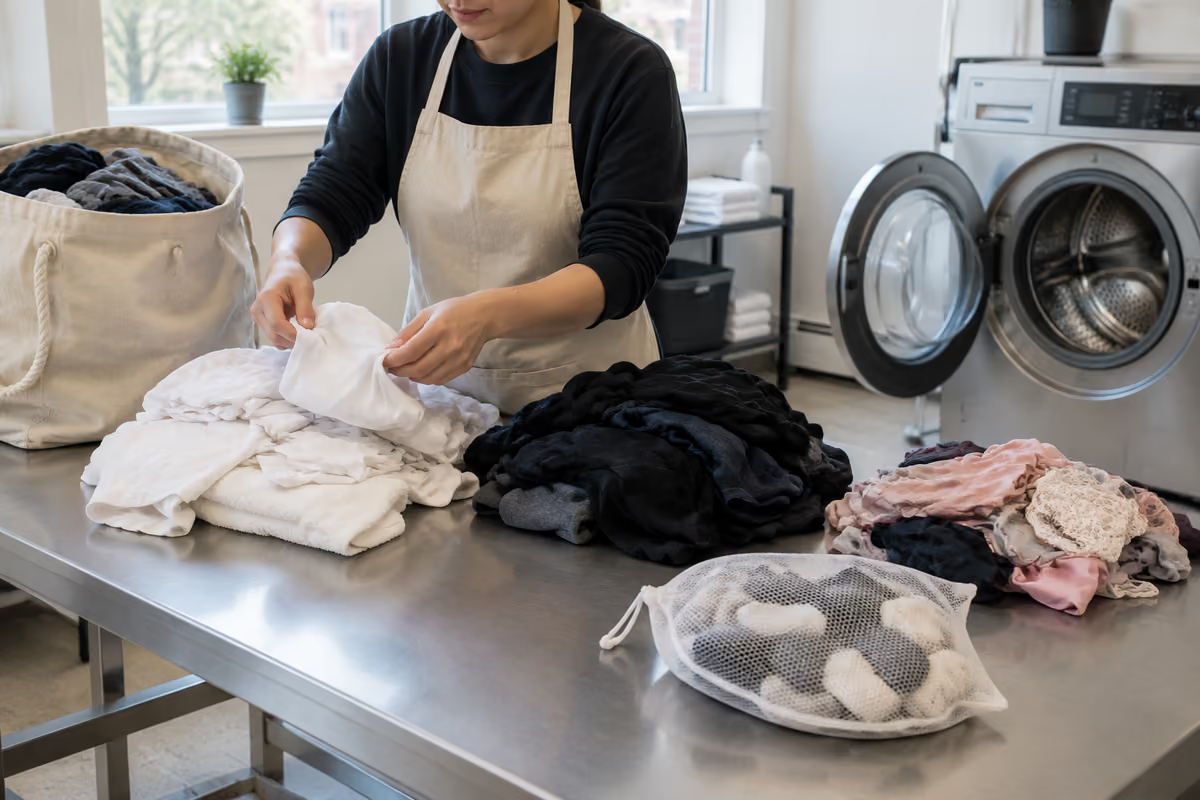
Bag opened and contents assessed
The bag is opened on a clean sorting table. If anything looks unusual, damaged, or out of the ordinary, it is photographed and noted against your order before proceeding.
Separated by colour and fabric
Items are divided into whites, lights, and darks. Within those groups, cotton, synthetic, and delicate fabrics are further separated so each load runs on the right settings.
Special handling items pulled aside
Anything with a dry-clean-only label, a care tag requesting hand wash, or a note from you in the booking is pulled from the standard flow and routed appropriately.
Pre-treatment of visible stains
Stains that are visible and treatable get a targeted pre-treatment before the load enters the machine. Set-in stains that are unlikely to lift are flagged so you know what to expect.
Loaded into the correct wash cycle
Each sorted group enters a machine on settings matched to its fabric and colour. Cold water is the default. Warmer settings are used only where the fabric genuinely benefits.
The sorting step matters more than most people expect, and it is worth pausing on why. At home, most of us sort loosely or not at all because the friction of running three separate loads for a single person feels excessive. In a facility setting, that friction disappears because multiple machines run in parallel and the volume makes fine sorting practical rather than wasteful. The result is that your white shirts never share a drum with a red sock, your synthetics never bake at cotton temperatures, and your delicates never tumble alongside denim. Each category gets exactly the treatment it needs rather than a compromised middle ground.
The cold-water default deserves its own explanation. Cold water is kinder to colour, gentler on fabric structure, and less likely to set protein-based stains like blood or sweat. It uses less energy, which matters at facility scale, but more importantly it protects your clothes from the two most common wash damages: colour bleed and shrinkage. Warm water is used only where it genuinely helps, primarily for heavily soiled whites and cotton towels that benefit from the extra cleaning power. If you have a preference for warm on specific items, a note in your booking overrides the default. But for most everyday loads, cold is both the safer and the more effective choice.
After the wash cycle completes, items move to the dryers. Heat is matched to the load category: cottons get standard heat to dry fully without excess time in the drum, synthetics get low heat to avoid melting or warping, and anything flagged as delicate either goes on a no-heat tumble or is laid flat to air dry. The distinction matters because over-drying is where most fabric damage actually happens in a laundry cycle. A slightly longer dry on low heat produces a better result than a shorter blast on high, and the facility has the machine capacity to give each category the time it needs without creating a bottleneck.
Standard items in your order go through our wash and fold service, which runs on fragrance-free detergent and cold water unless your account notes say otherwise. If you want to understand how we think about sorting categories and why certain separations matter for fabric longevity, we wrote about our sorting standards in detail.
When dry-clean items are mixed in
Not everything in a pickup bag belongs in a wash-and-fold cycle, and the sorting station is where that gets decided. Structured garments like blazers and suit jackets, anything carrying a dry-clean-only care label, silk, wool pieces that water would felt or distort, and leather or suede accents are all pulled from the standard flow at step three of the sorting process and routed to dry cleaning instead.
You do not need to pre-separate these items yourself, though you can if you prefer. If you know a particular garment needs dry cleaning, noting it in your booking helps the sort team confirm rather than guess. But the sort step is also designed to catch the obvious cases on its own: a care label saying "dry clean only" is a clear signal, and it is checked as a matter of course. The goal is that you can drop your entire wardrobe into one bag without worrying about routing, and the right items end up on the right track regardless.
Once pulled, dry-clean items follow their own processing path. They are cleaned using solvent-based methods that protect the fabric structure in ways water cannot, pressed or steamed as appropriate, and inspected before being packaged. The timeline for dry cleaning is typically slightly longer than a standard wash cycle, but in most cases the items are reunited with the rest of your order at the folding and packaging stage before the delivery window opens.
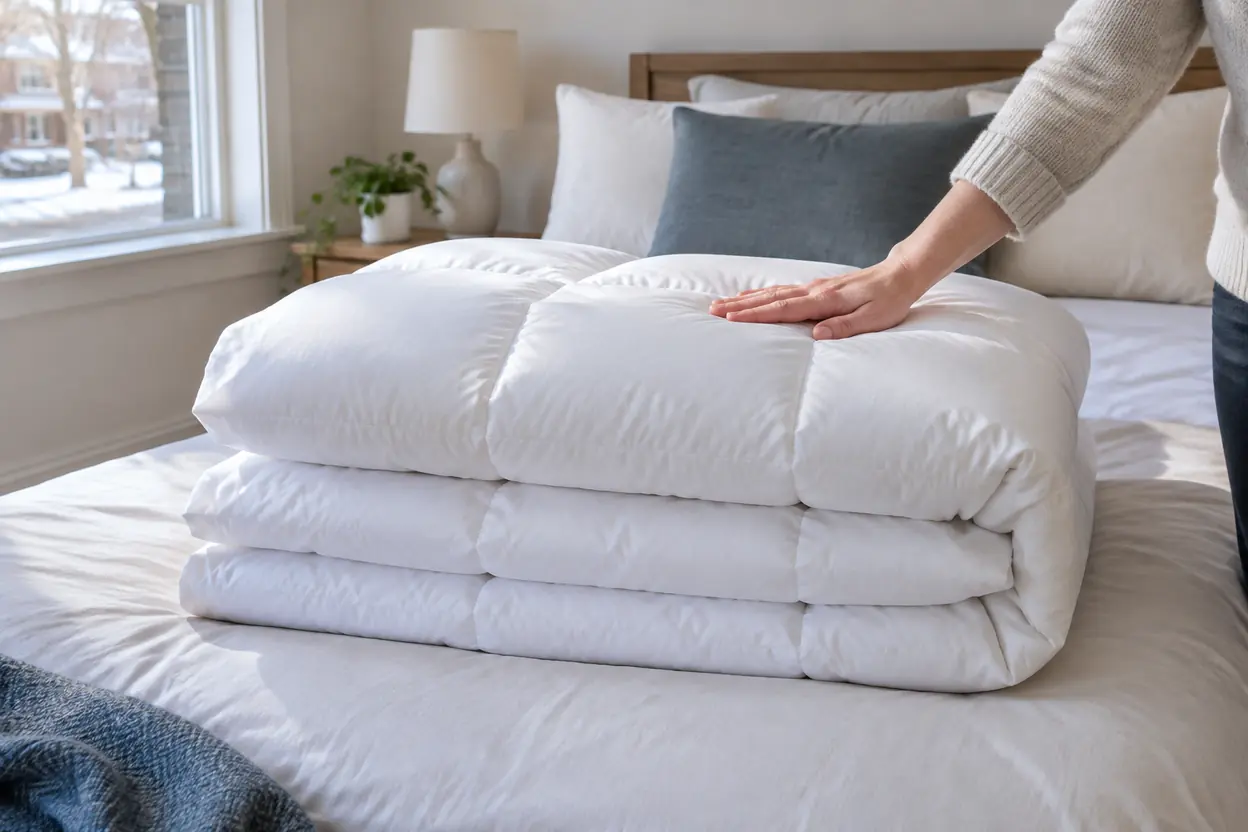
The split-and-reunite pattern applies to other specialty items too. A comforter cleaning workflow follows a similar path: the bulky item exits the standard flow at sorting, gets its own oversized wash and extended dry cycle, and comes back together with the rest of the order at packaging. The principle is the same in every case. Items that need different treatment get different treatment, and the system is built to merge everything back into a single delivery rather than requiring you to book separate pickups for separate categories.
If dry-clean items extend the processing time past the standard turnaround window, we notify you in the app with an updated delivery estimate rather than rushing the garment through an abbreviated process. This is rare for standard dry-clean pieces but can happen with heavily soiled or delicate items that need extra attention. The priority is always the garment over the timeline.
Quality check before delivery
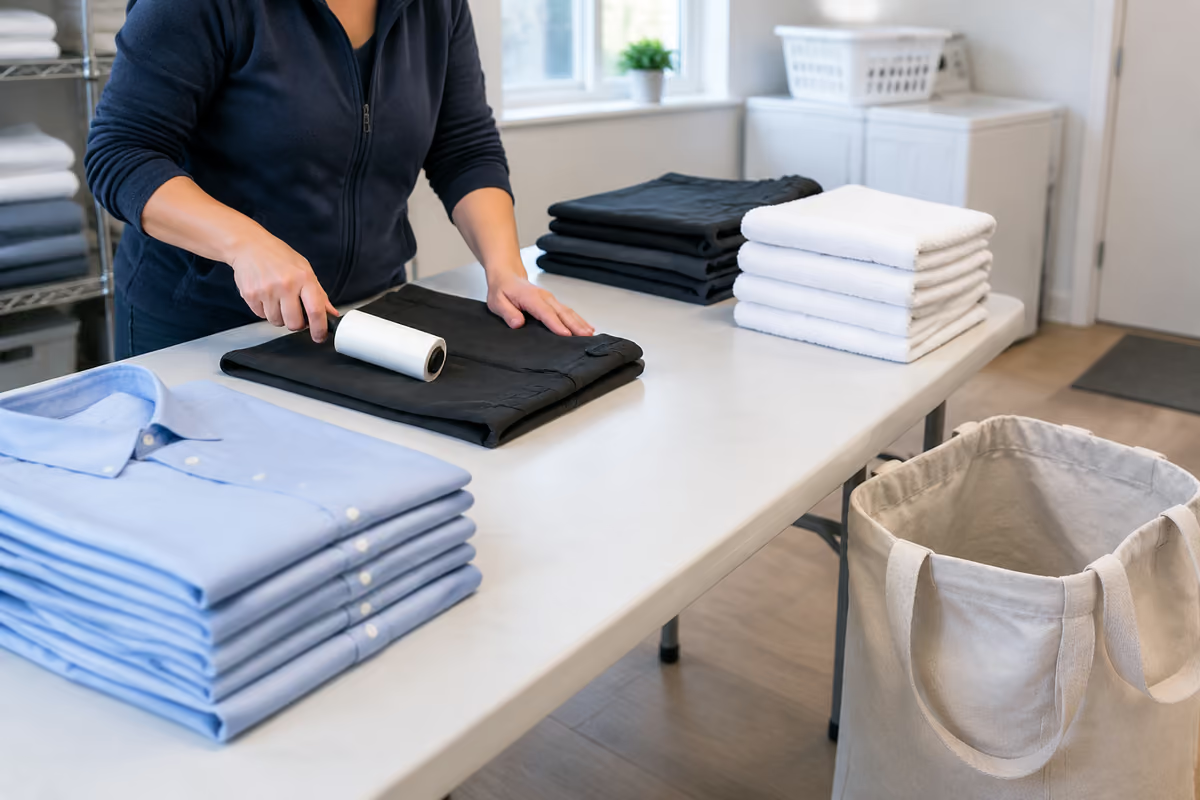
Before any order leaves the facility for the return trip, it passes through a quality check. This is not a cursory glance. It is a structured inspection against a defined standard, the same standard applied to every order regardless of size or service type, and it is the final gate between the fold table and your doorstep.
12-point
quality check points inspected on every order
That twelve-point check covers the fundamentals: correct fold standard per item type (shirts folded flat with collar aligned, pants folded along the crease, towels in thirds), no remaining visible stains that were treatable, no items damp or insufficiently dried, no fabric damage introduced during the cycle, correct item count against the intake log, no colour transfer between items, no lint or pet hair remaining on dark fabrics, packaging clean and presentable, order label correct, delivery address confirmed, and no items from another order mixed in. The final two points are a visual standard check on the overall presentation and a sign-off by the person who performed the inspection.
The fold standard itself is worth a few words because it is one of those details that separates a professional result from a home fold. Shirts are folded with the front facing up, collar aligned, sleeves tucked symmetrically, and the body folded to a consistent width that stacks cleanly. Pants follow the natural crease line and fold into thirds. Towels fold into thirds lengthwise and then in half, which is the shape that fits most bathroom shelves without re-folding. Fitted sheets are folded into a neat rectangle rather than balled up, which anyone who has fought with an elastic corner at home will appreciate. The goal is that everything comes back ready to put directly into a drawer or onto a shelf without additional handling on your end.
Loose-item recovery is another part of the quality check that runs quietly in the background. Socks, small undergarments, and washcloths are the items most likely to travel between loads in a facility environment. Each order's item count is logged at intake, and the quality check confirms the count matches at output. When something is missing, the team checks the previous and following loads in the drum sequence, the lint traps, and the sort table before flagging the discrepancy. In the rare case an item genuinely cannot be located, you are notified through the app with a description of what is missing and what steps were taken.
The check exists so that what arrives at your door is exactly what left the fold table. If you have a question about how something was handled, your order record in the customer app keeps the full status history and the weigh-in photo, so there is a reference point to start the conversation from.
From the operator's side
The quality check is also where the operator's perspective comes through most clearly. The facility is not a faceless warehouse. It is a small operation where the person folding your shirts is often the same person who will notice if a collar is fraying or a seam is coming loose. That proximity between the work and the worker is what makes a single-operator model different from a marketplace where your clothes pass through whoever is cheapest that hour.
Every order that leaves this facility is one I would be comfortable receiving myself. That is the standard, and it does not shift based on volume or schedule pressure. If an order is not ready, it waits until it is. Rushing a fold or skipping a stain check to save ten minutes is never worth the result it produces.
That perspective shapes how the entire process is structured. The quality check is not an afterthought added to catch mistakes. It is the point of the whole chain. Every station upstream, the sort, the wash, the dry, the fold, exists to produce an order that passes the check on the first pass. When something does not pass, it goes back to the appropriate station rather than being waved through with a note. A shirt with a visible stain that was missed during pre-treatment goes back to pre-treatment. A towel that is not fully dry goes back to the dryer. The check is the standard, and the standard does not flex for convenience.
This is also why accountability matters in a way that larger services cannot replicate. When one team owns the entire process, a quality failure is not lost in a chain of handoffs between contractors. It is immediately visible, immediately traceable to a specific station and a specific moment, and immediately correctable. The person who folded the order is the same person who inspects it. There is no gap between the work and the accountability for that work, which is how the standard stays consistent from one order to the next rather than drifting as volume grows.
The practical effect for you as a customer is simple: what passes the check is what you get at your door, and if something is not right, the conversation about fixing it happens with the person who actually handled your laundry rather than a support agent reading from a script three time zones away.
When the turnaround runs long
Not every pickup returns at the early edge of the window, and understanding when and why the cycle extends helps set accurate expectations rather than leaving you wondering whether something went wrong.
The most common reason for a longer turnaround is timing. An order that reaches the facility late in the day, or on a heavy day, may not have enough hours left for every station to complete properly. Rather than compress the wash or rush the dry cycle, we move the return to a later delivery window inside the 48-hour turnaround. This is not a failure or a delay in the negative sense. It is the system working correctly by protecting the quality of the result over the speed of the return.
When a delivery window moves
When a delivery moves to a later window, whether due to timing, an item needing extra care, or a stain that requires a second treatment pass, the team adds a note to the order in your customer account with the reason and the new delivery window so you can plan accordingly. You never have to wonder or check in.
The second reason for a longer turnaround is item-specific care. A stain that did not lift on the first treatment pass may get a second application and a second wash cycle, which adds two to three hours to the timeline. A delicate garment that needs air drying rather than machine drying takes longer by nature. A comforter or duvet that needs an extended dry cycle to ensure no moisture remains in the fill can add an hour or more compared to a standard load. In each case, the choice is between rushing the item and risking damage, or taking the extra time and delivering a result that meets the standard. We always choose the latter.
Seasonal volume can also shift timelines slightly. During peak periods, typically September when university students return and January when post-holiday cleaning surges hit, the facility runs at higher capacity. Orders still move through the same sequence, but the queue at each station may be slightly deeper. The standard 48-hour turnaround still holds, but the delivery window may land closer to the later edge of the range rather than the early side. We communicate this proactively in the app when volume is elevated so expectations match reality.
The key point is that a longer turnaround is always a deliberate choice made in favour of doing the work properly, never an accident or a mistake. And you know about it before it happens rather than discovering it when the delivery window passes.
It is also worth noting that these extensions do not affect your pricing. The per-pound rate and any flat-item charges remain exactly the same whether the order returns on the standard turnaround or takes an extra window. The extension is a service decision made in your favour, and it never carries a surcharge or a penalty. The only thing that changes is the delivery window, and that change is communicated clearly the moment it is decided rather than after the fact.
How tracking shows up in your app
From the moment your pickup is booked, your order carries a status that updates as it moves through the process. The order page in the customer app shows where it stands and when each step happened.
The status sequence for a standard order looks like this: pickup scheduled, on the way, picked up, weighing, cleaning, cleaned, out for delivery, delivered. Each transition happens when the real event occurs, not on a timer or an estimate. When your order moves from weighing to cleaning, it is because the bag has actually been weighed and started its wash, not because a clock ticked over.
The weighing step carries a photo. Your bag is photographed on the scale at weigh-in, and that photo is attached to your order as proof of the weight you are billed for. It is not a marketing image. It is a functional record of your specific order at the moment the price is set.
Email updates are triggered by status transitions. You can see the current status at any time by opening the order, but you do not need to check actively. We email you at the moments that matter most: when the bag is picked up (confirming collection), when it is cleaned and ready for delivery (so you know it is coming back), and when it is delivered (confirming arrival). Intermediate statuses are visible if you want to look, but they do not generate notifications because they do not require any action from you.
Three emails per order is a deliberate limit. More messages would add noise for events that do not require any attention, and the order page already holds the richer context (the weigh-in photo, timestamps, status history) whenever you want it. The information waits for you to look rather than interrupting whatever you are doing.
If something unusual happens during processing, like a stain that needs a second pass or an item that needs to be flagged, the team adds a note to your order that appears in the app alongside the status event. You do not need to call or message to find out what is happening. The information comes to you, attached to the order, with enough context to understand the situation without a back-and-forth conversation.
The tracking system also retains history. After delivery, your order record remains accessible with the full timeline of events, the weigh-in photo, and any notes from the team. This is useful if you have questions about a specific order days or weeks later, because the record is complete rather than being a receipt that shows only the start and end of the process.
The design philosophy behind the tracking is worth naming, because it explains choices that might otherwise seem arbitrary. The system shows you everything that happens but only interrupts you for things that matter. Status transitions update silently in the background, available when you want them, never demanding attention when you do not. The three email triggers (picked up, ready for delivery, delivered) are the three moments where knowing changes what you might do: you might check the spot after pickup confirmation, you might plan to be around once the order is ready, you might retrieve the bag after the delivered email. Everything else is informational, and informational data should wait for you to ask rather than competing for your attention alongside messages from people you actually want to hear from.
For recurring customers, the order history builds into a useful reference over time. You can look back and see how long your typical order takes, whether your loads tend to be consistent in weight, and whether any items have been flagged across multiple orders. If the same garment keeps arriving with a stain in the same spot, that history makes the pattern visible in a way a single-order receipt never could, and the team can flag it proactively rather than treating each occurrence as an isolated event. That longitudinal view is something you would never get from a drop-off counter or a shared laundry room, and it gives you a quiet advantage in managing your wardrobe over the long term.
What the laundry pickup process means for your routine
Understanding the process changes how most people think about the service. When the middle stretch is invisible, pickup feels like handing your clothes to a stranger and hoping for the best. When you can see the stations, the timing, the quality check, and the tracking, it starts to feel like what it actually is: a well-structured operation that does the same work you would do at home, but with better machines, more space, proper sorting, and a defined standard that every order is checked against before it comes back.
The transparency is not an afterthought or a marketing angle. It is the product. A laundry service that hides its process is asking you to trust on faith. A service that shows you the timeline, photographs your bag on the scale, and updates your order at every stage is earning trust through evidence. The two approaches produce very different relationships between the service and the customer, and we chose the second one on purpose because it is the one that survives past the first order.
For most new customers, the anxiety of a first pickup dissolves somewhere around the second or third status update. You see the bag was collected, you see the weigh-in photo, you check later and it is in cleaning, and by the time the "ready for delivery" email arrives you have stopped thinking about it entirely. That progression from anxiety to confidence to forgetting-about-it-completely is the goal of the entire tracking system. It exists to make itself irrelevant, because once you trust the process you stop needing to watch it.
The practical implication is that your evening stays yours. You do not need to wonder whether the bag was collected. You do not need to call and ask where your laundry is. You do not need to worry about whether something will be handled correctly. The system tells you what is happening, the process ensures it happens to a defined standard, and the result arrives at your door in the condition the quality check confirmed. That is the full arc of a pickup, and now that you have seen it from the inside, the only thing left is to experience it once for yourself.
The laundry pickup process in Ottawa is built around a simple principle: every step should be visible, every transition should be confirmed, and the result should meet a standard that does not depend on who handled it or how busy the day was. Whether you book weekly, biweekly, or as a one-time trial, the process is the same, the standard is the same, and the tracking shows you the same level of detail. Consistency is not a feature we add on top. It is the foundation the whole operation is built on.
Most people who try a first pickup and come back for a second one say the same thing: the anxiety was entirely front-loaded. Once you have seen the status updates roll in, watched the timeline progress from pickup to delivery, and opened the bag to find everything folded and accounted for, the process stops feeling new and starts feeling like an ordinary part of the week. The second order takes less thought than the first, and by the third you have likely stopped watching the app entirely because you already know what it will say. That progression from cautious observer to relaxed routine is the natural arc of the experience, and it happens faster than most people expect.
laundry pickup process Ottawa
48-hour laundry timeline
after laundry pickup
laundry tracking app
wash and fold process
laundry quality check
laundry sorting steps
laundry pickup delivery turnaround
laundry status updates
laundry pickup proof
laundry handling steps
laundry pickup workflow
Ready To Book
Hand off the laundry in under two minutes.

Reader handoffCopy, email, print, or return to the archive.
Share or save
Send this Ottawa laundry guide to someone who needs it.
Share the ottawa laundry guide with a roommate, property contact, or teammate before pickup notes get messy. The controls stay local to this page: no tracking widgets, no third-party script, just practical laundry tips Ottawa readers can pass along.
Services that pair with this guide
Services that pair with this guide.
Use the related services below when these laundry tips Ottawa readers need to turn a guides note into a pickup, a wash and fold order, or a question about specialty handling.
Related services


Related laundry searches.
Ottawa laundry guides continue from a real service page. Every search below lands on a live route.

Done reading?
Use the guide, then hand off the laundry.
This guide should leave you with a clearer next step. Book a pickup when the load fits standard laundry, or contact us when care labels, volume, bedding, or business needs deserve review first.