Wash and Fold Service vs Doing Your Laundry at Home
A side-by-side comparison of wash and fold service in Ottawa versus doing laundry at home, weighing time, utilities, fabric care, and total weekly cost.
- Duong Quan Nguyen
- Updated April 30, 2026
- 21 min read
Read the guide
Keep the guide open while the Laundryless route stays clear.
Use the 10 jump links to move through this guides article without losing your place. On wider screens the dispatch rail stays beside the Ottawa laundry guide while the body keeps the original blog typography.
Guides
Quick answer
Doing laundry at home costs less in dollars if you do not count your time. Wash and fold wins when your evenings are scarce, since it trades a published per-pound rate for the hours spent washing, drying, and folding. Sending out only bedding and towels is a middle path.
Doing laundry at home feels free. You own the machines, or at least you have access to them down the hall, and the detergent is already under the sink. No invoice arrives at the end of the week. But that sense of zero cost is an illusion built on invisible spending: your time, your electricity, your water, your equipment wearing down one cycle at a time. A wash and fold service replaces that invisible spending with a published per-pound rate, and the question every Ottawa household eventually asks is whether that trade makes sense for them.
This post counts everything. We will stack your real weekly hours against the service hours, your utility bills against the per-pound fee, and the wear patterns of a home dryer against an industrial one. By the end you will have a clear picture of both sides, honest enough to let you stay with your current routine if it genuinely serves you, or switch without second-guessing if it does not.
What wash and fold actually means
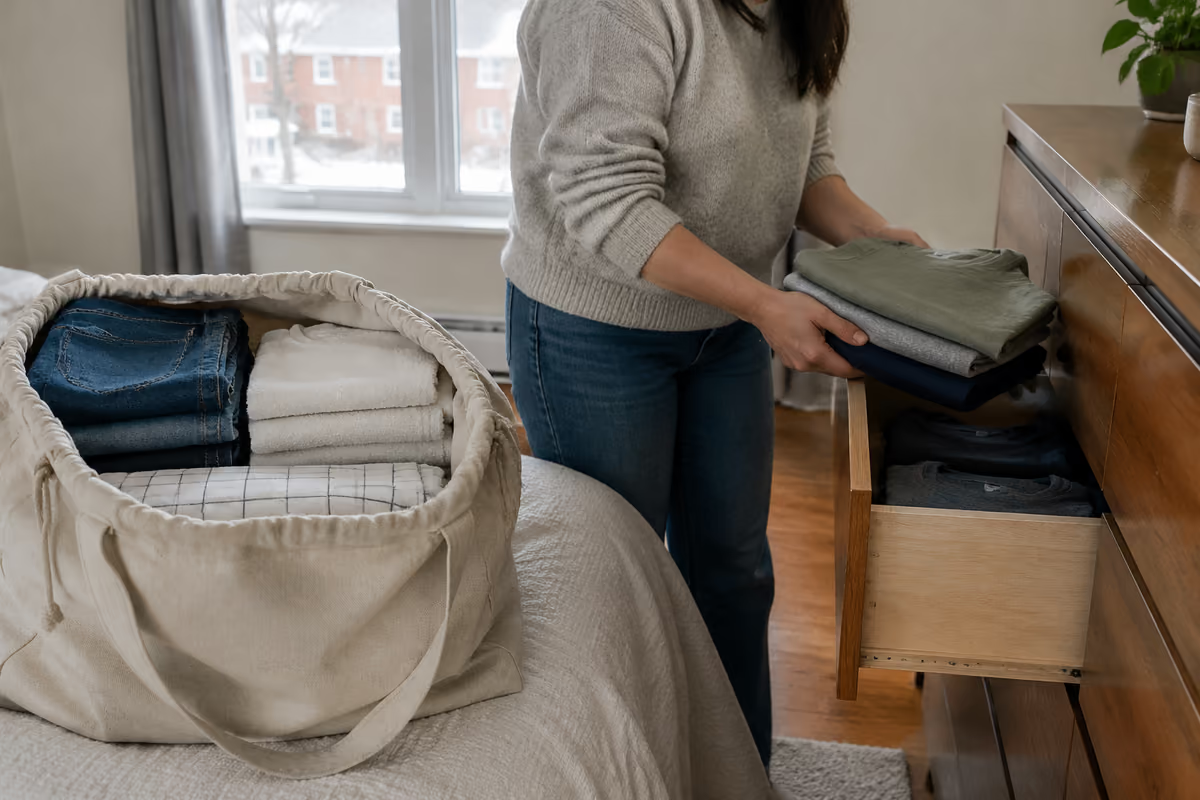
Wash and fold is a laundry service where someone else washes, dries, and folds your everyday clothing and household textiles to a consistent standard. You hand over a bag of dirty laundry and receive it back clean, dry, and folded, ready to put directly into a drawer or onto a shelf. The name is literal: washing happens, folding happens, and nothing else is implied.
It helps to be clear about the boundary. Wash and fold covers machine-washable items: t-shirts, jeans, underwear, socks, towels, bedsheets, gym clothes, casual pants, hoodies, and similar everyday fabrics. It does not cover garments that need dry cleaning, items that require ironing to a pressed finish, or pieces that need mending or alteration. Those are separate services with separate pricing, and bundling them under one name would only create confusion.
The scope matters because it shapes expectations. When you send a bag to a wash and fold service, you are not hiring a personal valet or a tailor. You are handing off the repetitive, time-consuming bulk of your weekly laundry to someone with better equipment and a system for moving through it efficiently. The clothes come back clean and neatly folded, not starched or pressed or wrapped in tissue paper. That is the promise, and it is a useful one precisely because it is modest and reliable rather than extravagant and inconsistent.
Most wash and fold operations, including ours, price by weight. You pay a flat rate per pound of laundry, with a minimum order that ensures the pickup trip is worth running. The rate is published before you book, so you can estimate the cost of a typical week at your kitchen table without ever speaking to anyone. There is no consultation, no fitting, no back-and-forth about what counts as a "load." You bag it, we weigh it, and the published rate applies. That simplicity is the whole point of the model.
How much time you really save
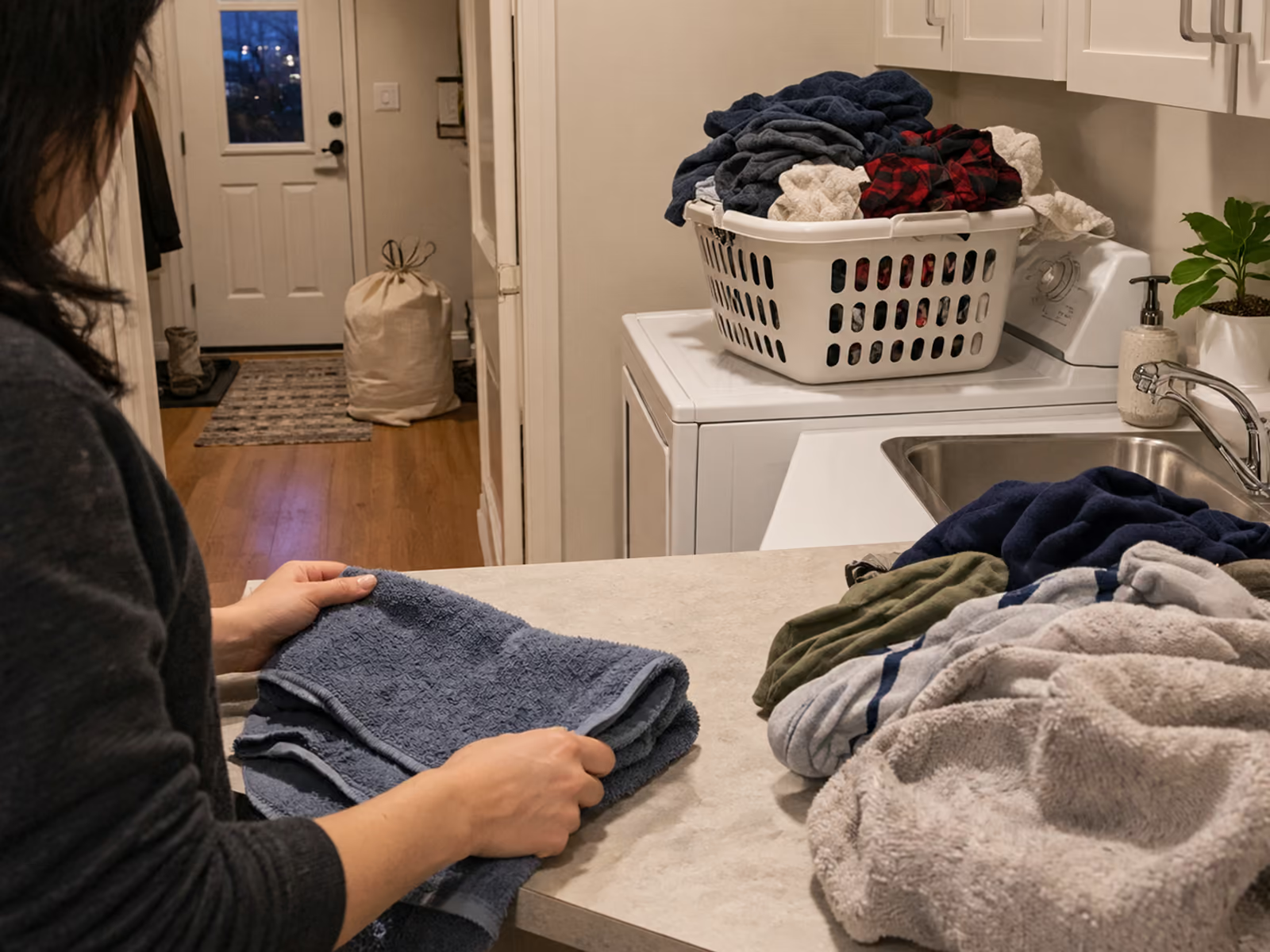
Time is the cost that never shows up on your hydro bill, which is exactly why most people undercount it. Think about what a single load of laundry actually asks of you at home. You sort the colours, load the machine, add detergent, start the cycle, wait thirty to forty minutes, move everything to the dryer, wait another forty to sixty minutes, pull it out, fold it, and put it away. That sequence takes roughly ninety minutes of elapsed time per load, and most of that time is not truly free. You are tethered to the house, listening for the buzzer, unable to leave for a long errand or settle into deep work because the next step is always fifteen minutes away.
Now multiply. If you run two loads a week, which is modest for a single person and light for a couple, you are spending three hours every week managing laundry. A family of four doing three or four loads a week is looking at four and a half to six hours. Over a full year that arithmetic lands somewhere most people have never calculated.
78 hrs
hours a year spent on laundry for a weekly household
Seventy-eight hours is what a single person doing one load per week, at ninety minutes per load, accumulates across fifty-two weeks. That is nearly two full working weeks surrendered to a chore that does not require your specific expertise, your creativity, or your presence. A couple running two loads a week doubles that to one hundred and fifty-six hours. A family with young children can easily triple it. The number is not dramatic. It is simply honest, and once you see it you cannot unsee it.
A wash and fold service compresses your side of that time down to the minutes it takes to bag the laundry and leave it at the door. The sorting, washing, drying, and folding happen elsewhere, on someone else's clock, and the finished result comes back ready to shelve. Your ninety-minute loop per load becomes a two-minute handoff, and the hours you were spending come back to you as evenings, weekend mornings, or whatever else you would rather be doing with an uninterrupted stretch of time.
The time argument is not about laziness. It is about opportunity cost. Those seventy-eight hours could be a side project, a workout routine, bedtime stories with your kids, or simply rest. The question is not whether you can do laundry at home. You obviously can. The question is whether the hours it takes are worth more to you than the per-pound fee that buys them back.
Side-by-side comparison
With the time picture established, let us put the two options next to each other across every dimension that matters for a weekly decision. Some rows favour home, some favour a service, and a few land close enough that your personal situation is the tiebreaker. The table below is honest about all three outcomes.
| Home laundry | Wash and fold service |
|---|---|
| Roughly 90 minutes per load, with you present for transitions between washer, dryer, and folding. | Two minutes to bag and leave at the door. The rest happens on someone else's clock. |
| No invoice. Cost is hidden inside hydro, water, detergent, and machine depreciation. | A published per-pound rate you can calculate before booking. |
| Quality depends on your equipment, your sorting habits, and how much attention you give each load. | Industrial machines with controlled temperature, proper sorting by colour, and consistent folding. |
| Stain treatment is whatever you remember to apply before the wash starts. | A pre-treatment step catches stains at intake before a single machine runs. |
| Folding is however neat you feel like being on a Sunday evening. | Folding follows a standard. Shirts come back with consistent creases ready to stack. |
| Bulky bedding barely fits a residential drum. Comforters bunch, dry unevenly, and sometimes need a second cycle. | Industrial capacity handles king duvets and heavy blankets in a single balanced cycle. |
| Small loads run anytime you want, no minimum, no scheduling. | A minimum weight applies per order, so very small loads are less efficient to hand off. |
The pattern is clear if you step back. Home wins on spontaneity and cost invisibility. Service wins on time, equipment quality, and consistency. Neither side dominates all seven rows, which is exactly why the decision depends on what you value most in a given week. If control and ritual matter more than recovered hours, home is fine. If hours matter more than ritual, the service is the rational trade.
One row deserves extra attention: the bulky bedding line. Ottawa condos and apartments commonly have stacked washer-dryer combos with a capacity that tops out around four cubic feet. A king comforter compressed into that drum does not wash evenly and often requires a second dryer cycle to shed moisture from the core. Industrial front-loaders run at eight to twelve cubic feet, which means the same comforter tumbles freely, washes uniformly, and dries in a single pass. The difference is not subtle. It is the difference between a duvet that smells faintly damp two hours later and one that is genuinely dry from edge to centre. If you have ever pulled a comforter out of your dryer and wondered why it still feels heavy, drum capacity is the reason, and it is a structural limit that no amount of care will overcome in a smaller machine.
The cost row also warrants a closer look, because "hidden" and "zero" are not the same word. Your hydro bill, your water usage, the detergent you purchase, and the slow depreciation of machines that will eventually need replacing are all real expenditures. They simply never present themselves as a single line item labeled "laundry." A service makes the cost visible and predictable, which some people find more comfortable even when the raw dollar amount is slightly higher, because budgeting against a known number is easier than budgeting against a scattered collection of invisible ones.
When doing laundry at home wins
Honesty demands a section that argues against the service, because home laundry genuinely is the better fit for certain households, and pretending otherwise would be patronizing. If any of the following descriptions match your situation, you may not need to change a thing.
Home laundry wins for some households
This is not a section we included reluctantly. Understanding when a service is unnecessary is as useful as understanding when it helps. If you enjoy your laundry routine, have light volume, or have very particular care needs, the honest answer might be to keep doing what you are doing.
You enjoy the ritual. Some people genuinely find the rhythm of sorting, loading, and folding calming. It is a task with a visible beginning and end, a rare quality in a world of open-ended obligations. If your Sunday morning routine includes a coffee, a podcast, and a load of whites, and if that combination brings you genuine pleasure rather than resignation, then the time is not lost. It is chosen, and chosen time does not need to be optimized away. A service would simply remove something you like, which is not an improvement by any definition.
You have very specific care preferences that only you trust. Perhaps you hand-wash certain knits in a basin with a particular detergent. Perhaps you lay specific garments flat on a drying rack in a room with controlled humidity. Perhaps you have a routine for a wardrobe of vintage pieces that you would not delegate to anyone regardless of their competence. These are real situations, not unusual ones, and a flat-rate service that processes everyday fabrics efficiently is not designed to accommodate them. If your wardrobe is mostly special cases, the service covers too little of your total volume to justify the pickup.
Your weekly volume is genuinely tiny. A single person living alone who wears the same few outfits and runs one small load every ten days is not generating enough laundry to meet a 15-pound minimum comfortably. The math simply does not work at very low volumes. You would either need to accumulate over a longer stretch or supplement with towels and bedding to reach the threshold, and neither feels natural if your life produces less laundry than that.
You live in a house with your own full-size machines and a finished laundry room, and you have arranged your week so that laundry runs in the background while you work from home. In that configuration, the elapsed time is real but the active time is minimal, because you are already there and the machine handles itself between interventions. The argument about being tethered to the house carries less weight when you were going to be in the house anyway.
Our Ottawa pickup and delivery works for any frequency, weekly, biweekly, or as a one-off when life gets heavier than usual. Some customers use it every week. Others call on it once a month when the pile outpaces their willingness to deal with it. There is no contract that forces a rhythm, so even if home laundry is your default, the service can sit in the background as a relief valve for the weeks that overwhelm the routine.
When wash and fold wins
The opposite case is just as clear, and it applies to a larger slice of Ottawa households than most people expect. If your week looks anything like the "before" column below, the service is not a luxury. It is a practical trade that returns more than it costs.
Sunday with home laundry
- Sort colours and whites into separate piles
- Load the first batch and wait forty minutes
- Move to the dryer and start the second wash
- Fold the first load while the second dries
- Repeat until three loads are done by evening
- Realize the fitted sheet is still damp and re-run it
Sunday with wash and fold
- Bag everything into one bag the night before
- Leave it at the door before your morning coffee
- Spend Sunday however you like
- Monday evening: open the door to folded stacks ready to shelve
The contrast is not theoretical. It is the difference between a Sunday that revolves around a chore and a Sunday that does not. The laundry still gets done, the clothes still come back clean and folded, but the hours belong to you instead of to the washing machine.
Wash and fold wins most clearly in these situations. You live in a condo or apartment with a shared laundry room where machines are often occupied, unreliable, or inconveniently located in a basement you would rather avoid at night. The friction of waiting for a free machine, carrying baskets through hallways, and timing your visit around other tenants adds thirty minutes or more to every load, and that overhead disappears entirely when someone else handles the washing somewhere with dedicated capacity.
You are a working adult in Ottawa whose weekday evenings are already compressed between commuting, cooking, and whatever personal time remains. Laundry is the chore that always seems to fall on the one free evening you had planned for something else, and removing it from the rotation does not make your life easier in the abstract. It makes a specific evening each week feel longer and less fragmented.
You have children. The volume of laundry a family produces is relentless, and it scales faster than most parents expect. Between clothing, bibs, towels, bedding, and the constant stream of items that arrive home from daycare or school smelling of grass and paint, three loads a week becomes four, then five, and eventually the pile is a permanent fixture rather than a temporary one. Handing that volume to a service converts a daily obligation into a weekly handoff, and the hours that come back are the ones parents have least of.
You value consistency over control. A service folds the same way every time, sorts the same way every time, and treats stains before the wash rather than after you notice them in the dryer. If what you care about is a reliable outcome rather than a personal touch, the industrial approach delivers that reliability more consistently than a tired person folding at ten on a Sunday night.
The fabric care reality matters more than most people expect when weighing the two options, because the quality difference is not just about cleanliness. It is about how your clothes age over repeated washes, which is a cumulative outcome that only becomes visible after months of one routine or the other.
True weekly cost of doing laundry at home
Most people have never added up what home laundry actually costs per week. The number is not dramatic, but it is not zero either, and seeing it assembled in one place changes how the per-pound service fee feels. Below is a representative breakdown for an Ottawa household running three loads a week in a standard top-loader and electric dryer.
Weekly home laundry cost (3 loads)
- Detergent (per 3 loads)Mid-range liquid, roughly 60 cents per load
- 1.80
- Fabric softener or dryer sheetsOptional but common, roughly 25 cents per load
- 0.75
- Electricity (washer + dryer)Ontario hydro rates, 70 cents per load average
- 2.10
- Water (municipal rate)Roughly 35 cents per load for a standard top-loader
- 1.05
- Machine depreciationWasher + dryer at combined replacement cost spread over useful life
- 3.85
- Time at opportunity cost4.5 hours at a modest value of 12.50 per hour
- 56.25
Opportunity cost is subjective. Even at zero the material cost alone is roughly 9.55 per week.
The time line dominates, as it always does in these calculations, and some readers will object that their time is not worth anything because they would have been doing nothing otherwise. That is a valid position for some hours, but it rarely holds for all four and a half of them. Even if you discount the time entirely, the material costs alone, detergent, softener, hydro, water, and depreciation, run close to ten dollars a week. That is not nothing. It is simply invisible because it never arrives as a single invoice.
Now compare that to the service. At $3.19 CAD per pound with a 15-pound minimum, a typical single-person order of fifteen to eighteen pounds lands between roughly forty-eight and fifty-seven dollars. A couple's order of twenty to twenty-five pounds lands between sixty-four and eighty dollars. Those are real numbers and they are higher than the material-only home cost, which is the honest admission. The service costs more in visible dollars. But it costs less in total when you count the hours, and it costs dramatically less in cognitive load, because one predictable number is easier to budget than six scattered ones.
The full cost breakdown post walks through the math for different household sizes and frequencies in detail, including how recurring pickup schedules shift the per-pound economics. For the live rates across every service tier, the current wash and fold rates are published in one place, flat across all served Ottawa postal codes.
The depreciation line deserves a sentence of explanation because it is the one most people skip. A washer and dryer pair in Ottawa retails for somewhere between fifteen hundred and three thousand dollars depending on brand and capacity. If the pair lasts ten years, which is optimistic for a heavily used set, you are spreading that cost across roughly five hundred and twenty weeks. Even at the lower end, that works out to nearly three dollars a week in silent capital consumption. You do not feel it until the machine breaks and the replacement bill arrives all at once, but the cost was there every week whether you noticed it or not.
Electricity is the other line that surprises people. Ontario hydro runs on time-of-use pricing, which means a dryer cycle during peak hours costs more than the same cycle run overnight. Most households do laundry on weekends or evenings, both of which sit in the mid-peak or on-peak band, so the per-load cost is higher than the flat average would suggest. A modern heat-pump dryer brings this down, but those units carry a higher purchase price that shows up in the depreciation line instead. The cost does not disappear. It moves between rows.
Quality differences in practice

The gap between a home machine and an industrial one is not about effort or willingness. It is a structural difference in engineering that produces different outcomes regardless of how diligent you are. Understanding where that gap sits helps explain why clothes washed professionally often look and feel slightly different from clothes washed at home, even when both are technically "clean."
Industrial front-loaders used by wash and fold operations typically run drums between eight and twelve cubic feet, compared to the three-and-a-half to five cubic feet common in residential machines. That extra volume means clothes tumble freely rather than packing together, which has three consequences worth naming. First, detergent distributes more evenly because water moves through the fabric rather than around a compressed mass. Second, rinsing is more thorough, so less residue remains in the fibres after the cycle ends. Third, mechanical action is gentler per item, because the drum does not need aggressive agitation to move water through a tightly packed load. The paradox is counterintuitive: a bigger, more powerful machine is actually softer on fabric than a smaller one working harder to compensate for limited space.
Drying follows the same logic. Industrial dryers move a higher volume of air at a more controlled temperature, which means fabrics dry faster without needing higher heat. Home dryers compensate for limited airflow by running hotter or longer, and both strategies accelerate wear. High heat weakens elastic fibres, sets wrinkles, and causes cotton to contract. Long cycles at moderate heat are gentler but consume more energy and still subject fabric to extended tumbling. The industrial approach resolves both problems by moving more air through a larger space, which means a shorter cycle at a lower temperature achieves the same dryness without the trade-offs that come from either extreme.
Pre-treatment is another practical difference that adds up over months. In a home routine, stain treatment happens when you notice a stain and remember to apply something before the wash starts. In a service workflow, every item passes through an intake step where visible stains are identified and pre-treated as part of the standard process, not as an exception requiring initiative. The result is that stains are caught more consistently, treated with appropriate products matched to the stain type, and addressed before heat from the dryer sets them permanently. This is not a skill gap. It is a process difference: systematic pre-treatment catches what opportunistic treatment misses.
Folding consistency is the visible output of all the invisible steps above. A professional fold follows a repeatable standard: shirts are folded the same way every time, towels are folded the same way every time, and the stack you receive back is uniform enough to shelve without adjusting anything. Home folding varies with your energy, your attention, and whether you are folding fresh from the dryer or from a basket that has been sitting overnight. Neither approach is wrong, but one produces a consistent result by design and the other produces a variable result by nature.
The cumulative effect of these differences is most visible in how clothes age. Fabric that is washed gently, rinsed thoroughly, dried efficiently, and folded consistently degrades more slowly than fabric subjected to the stresses that smaller machines impose by necessity. Over a year of weekly washes, the difference between the two paths shows up as less pilling, fewer stretched necklines, less fading, and fewer items that quietly migrate to the "only wear at home" category. That long arc is the quality argument in its truest form: not that one wash is dramatically better than another, but that fifty-two slightly better washes compound into a wardrobe that lasts noticeably longer.
Common myths about wash and fold
A few misunderstandings persist around wash and fold services, and they are worth addressing directly because they influence decisions based on inaccurate assumptions rather than real experience.
The first myth is that a service will ruin your clothes. This concern usually comes from a bad experience at a coin laundromat years ago, or from the reasonable worry that a stranger will not care about your wardrobe the way you do. In practice, industrial machines are gentler on fabric than residential ones precisely because of the drum size and airflow advantages described above. The sorting and pre-treatment steps add a layer of care that most home routines skip entirely. Your favourite hoodie is safer in a twelve-cubic-foot drum tumbling freely than in a four-cubic-foot drum packed tight against your jeans and towels.
The second myth is that wash and fold is only for wealthy households. The per-pound rate is transparent and predictable, and when you factor in the utilities, detergent, machine wear, and hours you spend at home, the gap between the two options is far narrower than most people assume. For many dual-income households in Ottawa, the service costs less per week than a single takeout dinner, and it returns hours that no restaurant can give back.
The third myth is that you lose control over how your laundry is handled. Every reputable service lets you specify preferences at booking: wash temperature, fragrance-free detergent, air-dry for delicates, or any other instruction that matters to you. The difference between home and service is not presence versus absence of control. It is hands-on control versus communicated control, and communicated control works perfectly well when the person on the other end follows a documented process rather than winging it load by load.
The fourth myth is that pickup and delivery adds days to your turnaround. Many Ottawa customers assume their laundry will disappear for a week. In reality, most orders placed through a laundry pickup and delivery service come back within twenty-four to forty-eight hours, which is often faster than the multi-day pile-up that happens when home laundry keeps getting postponed because the weekend never feels long enough to catch up.
Related searches
People weighing a wash and fold service against doing it themselves tend to search the same handful of questions before they decide. If any of these brought you here, the comparison above covers the reasoning behind each one.
wash and fold vs home laundry
is wash and fold worth it
time saved with laundry service
wash and fold cost per pound
laundry pickup vs doing it yourself
wash and fold Ottawa
weekly laundry service cost
laundry service vs laundromat
wash and fold near me
The honest answer, and your next step
The honest answer is that neither option wins outright, because the two are not competing on the same axis. Doing laundry at home wins on raw dollars if you value your time at zero and enjoy the routine. A wash and fold service wins the moment your evenings and weekends become scarce enough that the hours matter more than the difference between a per-pound fee and your hydro bill. Most households do not sit at either extreme, which is why the partial approach, sending bedding and bulky items out while keeping everyday clothes at home, is such a common starting point.
What the comparison should leave you with is not a verdict but a clear frame. You now know the direct costs on both sides, the time each option consumes, and the fabric-care differences that a commercial drum brings. That is enough to make the call on facts rather than the vague sense that a service must be an indulgence.
When you want to see the exact per-pound figure for your volume, you can check the current rates or start a booking and the total will be clear before your card is charged.
Wash and fold service in OttawaSee how the per-pound service works, what is included, and the 48-hour standard and 24-hour rush turnaround windows across the city.Ready To Book
Hand off the laundry in under two minutes.

Reader handoffCopy, email, print, or return to the archive.
Share or save
Send this Ottawa laundry guide to someone who needs it.
Share the ottawa laundry guide with a roommate, property contact, or teammate before pickup notes get messy. The controls stay local to this page: no tracking widgets, no third-party script, just practical laundry tips Ottawa readers can pass along.
Services that pair with this guide
Services that pair with this guide.
Use the related services below when these laundry tips Ottawa readers need to turn a guides note into a pickup, a wash and fold order, or a question about specialty handling.


Related laundry searches.
Ottawa laundry guides continue from a real service page. Every search below lands on a live route.

Done reading?
Use the guide, then hand off the laundry.
This guide should leave you with a clearer next step. Book a pickup when the load fits standard laundry, or contact us when care labels, volume, bedding, or business needs deserve review first.