How to Prepare Your Laundry for a Scheduled Pickup
A practical checklist for preparing laundry for pickup in Ottawa: when to bag, what to flag, how to handle stains and delicates, and what to leave at the door.
- Duong Quan Nguyen
- Updated April 2, 2026
- 25 min read
Read the guide
Keep the guide open while the Laundryless route stays clear.
Use the 9 jump links to move through this tips article without losing your place. On wider screens the dispatch rail stays beside the Ottawa laundry guide while the body keeps the original blog typography.
Tips
Quick answer
The night before, empty every pocket, close zippers and buttons, pre-treat fresh stains, and pull out anything that is dry-clean only. Add any care preferences to your order notes, then leave the bag at the spot you chose for pickup.
Ten minutes the night before saves you a phone call the next day. That is not a figure of speech. It is the actual difference between a smooth morning pickup and an awkward exchange where something was missed, a pocket still had a receipt in it, or a bag ended up somewhere other than the spot you told us it would be. Preparing laundry for pickup is not complicated, but it does benefit from a short, sensible routine you can do while the kettle boils or the dishwasher runs.
If you have already booked a scheduled laundry pickup, this is the prep that makes the morning effortless. What follows is the complete guide: a night-before checklist, a sorting primer, a five-step flow you can repeat without thinking, notes on what to flag and what to keep out of the bag, and seasonal adjustments for Ottawa weather. Each section is designed to be read once and then skipped on future orders, because the habits you build the first time carry forward on their own.
The goal is not perfection. You are not packing a museum exhibit. The goal is a bag that arrives in a state where nothing goes wrong: no stains set deeper, no socks vanish into a fitted sheet, no dry-clean-only blazer accidentally enters a wash cycle it was never meant to see. That level of readiness takes a few minutes of attention and costs nothing beyond a brief pause in your evening. Once the routine clicks, it takes less time than brushing your teeth.
The night-before checklist
The evening before pickup is when most of the real work happens, and the word "work" overstates it. You are not deep-cleaning your wardrobe or reorganising a closet. You are running through a short mental list while you are already home, already comfortable, and already near the laundry. The reason to do it at night rather than in the morning is simple: mornings are rushed, evenings are not, and a bag prepped the night before means you literally walk past it on the way out the door without stopping.
Think of this checklist as the eight small actions that prevent the most common pickup problems. None of them takes more than a few seconds on its own. Together they add up to about ten minutes, and they save you from the one thing nobody wants: a follow-up message after pickup saying something was missed or could not be processed.
Night-before prep checklist
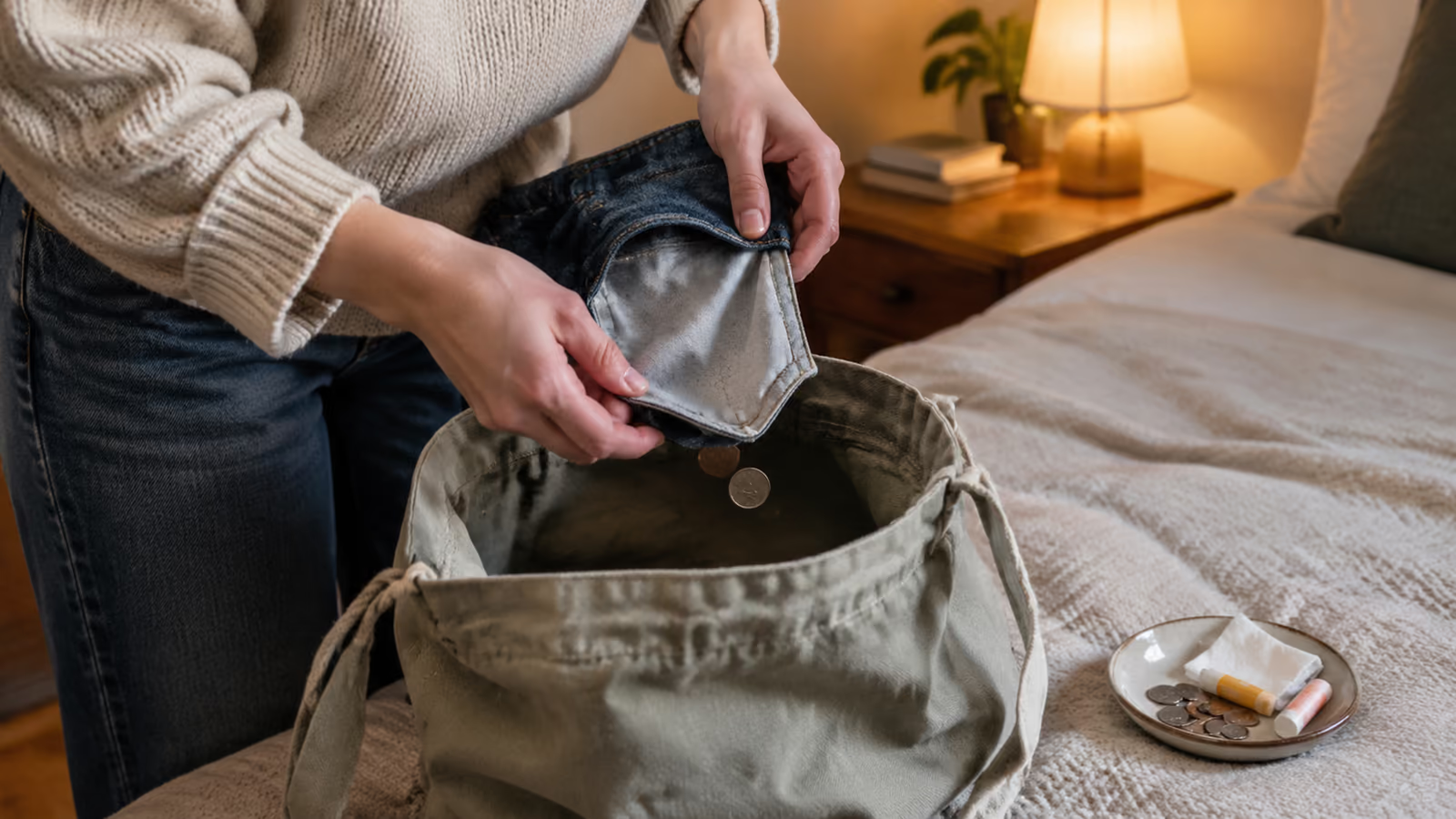
- Empty every pocket: coins, tissues, receipts, lip balm, pens
- Zip all zippers up, close buttons, tie drawstrings so nothing snags
- Turn jeans, dark tees, and printed items inside out
- Pre-treat any fresh stains you noticed today within four hours of bagging
- Group bedding into its own bag or section if the load is bulky
- Write any care preferences: warm wash, line dry only, fragrance-free
- Place the bag where you said it would be for morning collection
- Confirm the pickup window in the customer app so the slot is locked
A few of those items deserve a sentence of context. Pockets are the single most common source of problems. A tissue left in a pocket shreds during the wash cycle and deposits white lint across every dark item in the load. A pen is worse: ink on a dryer drum can mark garments for the rest of that cycle. Coins are less damaging but noisy, and they occasionally scratch the inside of a machine drum in a way that leaves marks on delicate fabrics. The fix is always the same: turn pockets out, check by feel, move on.
Zipping and fastening matters because an open zipper behaves like a tiny saw inside a tumbling drum. It catches on knit fabrics, snags bra straps, and can pull threads from towels. Ten seconds of zipping before bagging prevents a repair bill that costs more than the pickup itself. The same logic applies to drawstrings: a loose cord can wrap around smaller items and stretch them out of shape during the spin cycle.
Turning dark items inside out protects the visible face from abrasion. Denim fades faster when the outer surface grinds against other fabrics in the drum. Printed t-shirts crack and peel when the print faces outward during agitation. Inside-out is a one-second habit that extends the life of your most-worn pieces by months, and it costs nothing at all.
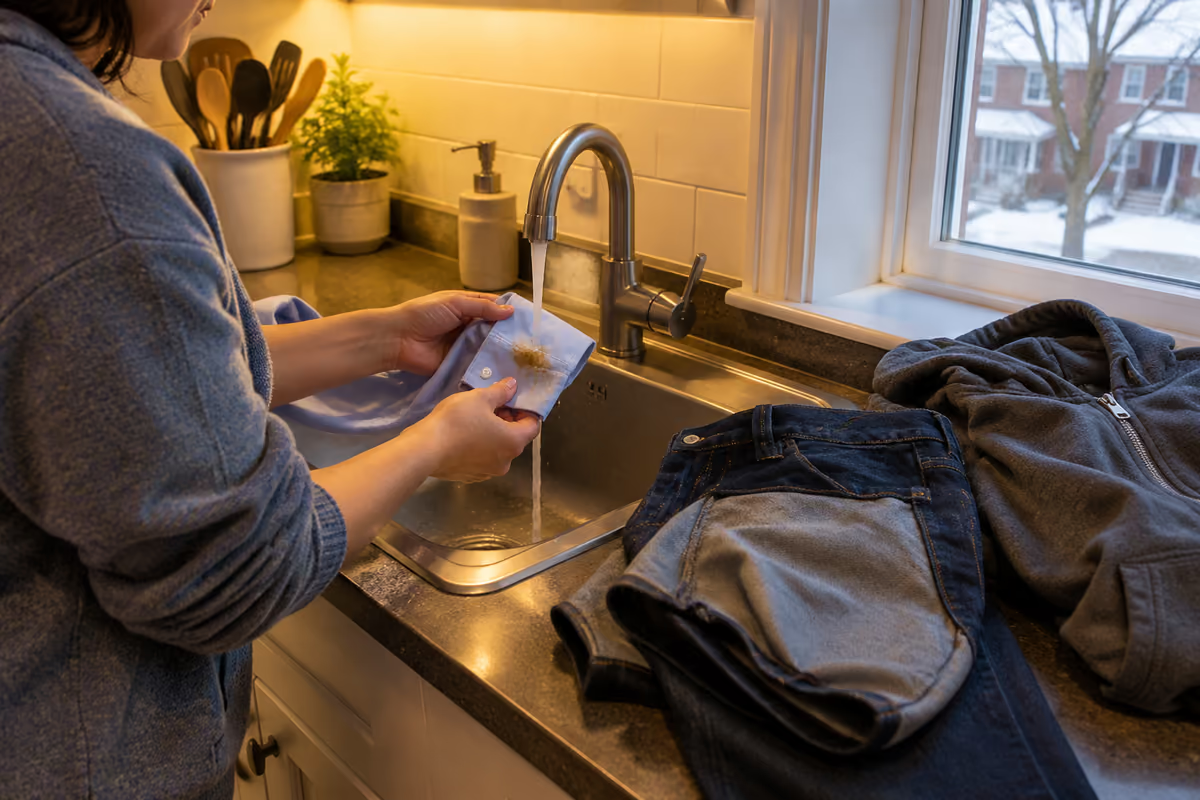
Pre-treating stains is the one item on this list that has a time component. A coffee spill treated within four hours lifts far more easily than one left to set overnight. If you notice a stain the day you are bagging, dab it with a stain remover or even cold water and a drop of dish soap before it goes into the pickup bag. You are not expected to fully remove it. You are just keeping the fibres from bonding permanently with the stain before we can get to it with proper equipment. If a stain is already days old, note it in your booking so we know to give it extra attention at the sorting step.
Sorting basics before pickup
You might wonder whether sorting still matters when you are handing laundry off to a service that sorts again at intake. The short answer is yes, but only lightly. We do a full colour and fabric sort once your bag arrives, so you are not responsible for getting it perfect. What a light pre-sort does is speed up the intake step and reduce the chance that something gets missed in a large, tangled mass of fabric. It also protects your own clothes during the hours between bagging and our sort station: a damp gym towel pressed against a silk blouse for six hours can transfer odour and moisture in ways that are hard to reverse.
The simplest pre-sort is a two-pile system. Pile one is everyday laundry: t-shirts, underwear, socks, jeans, casual trousers, pyjamas, towels. Pile two is anything that needs a different process: dry-clean-only items, heavily stained pieces that need spot treatment, delicates you want washed on a gentle cycle, or bulky bedding that takes up most of a bag on its own. Pile one goes straight into the bag. Pile two gets flagged, either in a separate sub-bag or with a note attached.
Heavy items go at the bottom of the bag. This is not a rule we enforce, it is a physics suggestion. Sheets and towels compressed under their own weight take up less space and leave room for lighter items on top. It also means the bag sits flat by your door rather than toppling over, which matters if you are leaving it in a shared hallway or lobby where it might be bumped.
Wet items deserve their own sentence, because this mistake is easy to make and hard to undo. Never bag damp clothes with dry ones. A single wet gym shirt sealed into a bag with the rest of your week's laundry creates a humid pocket that breeds mildew within hours. If something is still damp, either hang it to air-dry before it goes in or place it in a separate plastic bag inside the main bag so moisture cannot migrate. This one habit prevents the musty smell that occasionally surprises people when they open a bag they packed in a hurry.
If you are the sort of person who wants to go deeper on sorting, our deeper sorting guide covers fabric categories, colour-bleed risk, and the logic behind separating whites from lights from darks. For pickup prep purposes, though, the two-pile system and the no-damp rule are enough to keep your bag in good shape from the moment you close it to the moment we open it at intake.
One last sorting note that people often overlook: check for items that are not laundry at all. A child's stuffed animal, a decorative pillow cover that should be spot-cleaned rather than machine-washed, a rug that exceeds the weight your bag can hold. These edge cases are rare, but when they happen inside a mixed bag they slow down the entire order because they require a separate decision at intake. If you are unsure whether an item belongs in a standard wash cycle, leave it out and ask in your booking notes. We would rather answer a quick question than discover a problem mid-process.
A five-step prep flow for pickup morning
If the checklist above is what you do, this section is the order you do it in. Some people prefer a numbered sequence they can run through mechanically rather than a list they scan for whatever catches their eye. This five-step flow covers the same ground in a fixed order that moves from inside the laundry pile outward to the door, so you never have to double back.
The flow assumes you are doing this the night before, which is when we recommend it. If you are a morning person who prefers to bag at six in the morning, the same steps apply, just compressed into a shorter window. The key is that by the time you leave for your day, the bag is staged, tagged, and sitting where we expect to find it.
Empty and check every pocket
Turn each pair of trousers, each jacket, and each hoodie inside out at the pockets. Feel the seams. Remove everything you find: coins, crumpled tissues, receipts, headphones, lip balm, pens. This single step prevents more pickup issues than all the others combined.
Separate dry-cleaning items into a marked sub-bag
Anything with a dry-clean-only label, structured blazers, wool trousers, silk blouses, goes into its own bag or tied bundle. A simple note that says dry clean is enough. This keeps them out of the wash cycle entirely and routes them to the right process at intake.
Pre-treat visible stains while they are fresh
Spray or dab any stain you noticed today with a stain remover, or cold water and dish soap if you have nothing else. You do not need to scrub or rinse. Just break the surface bond so the stain does not set further overnight. Flag old or stubborn stains in your booking notes.
Bag with heavy items on the bottom and soft fabrics on top
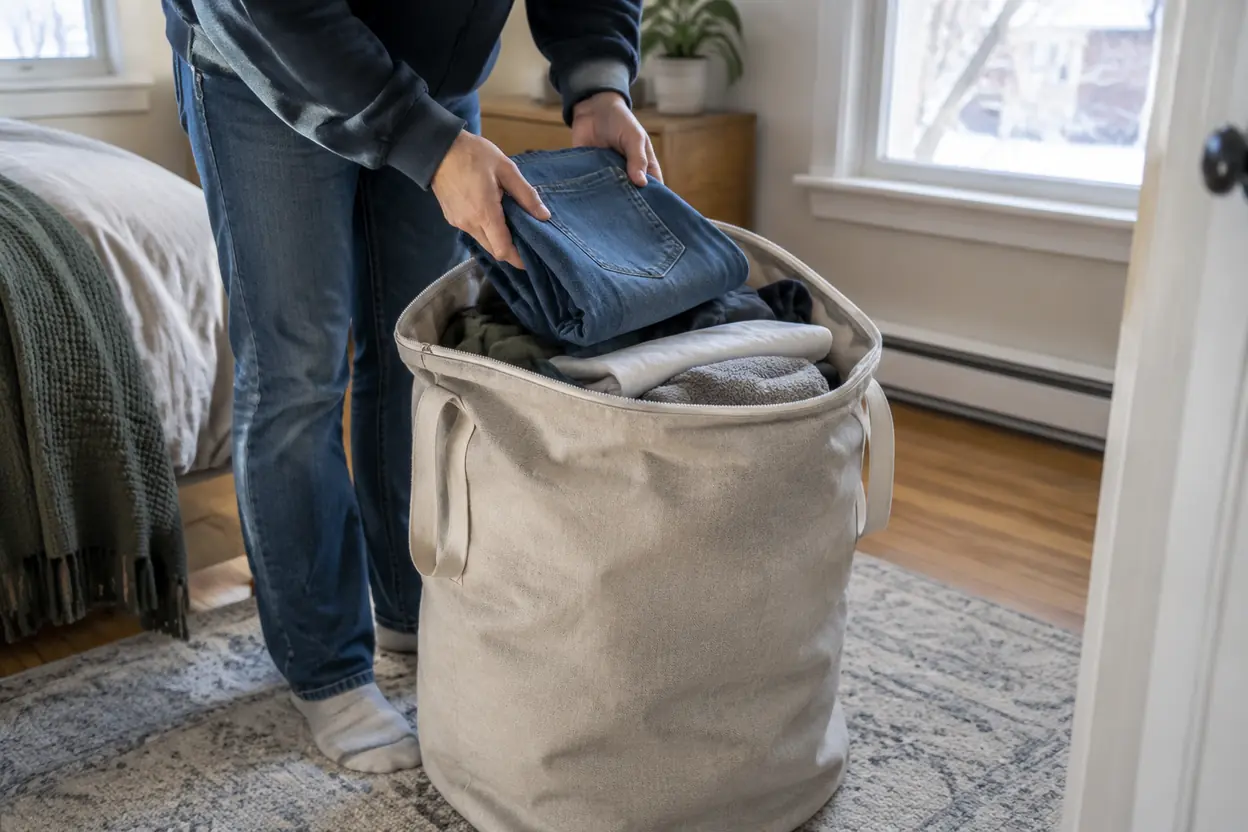
Bedding, towels, and jeans go in first. Lighter knits, t-shirts, and underwear sit on top. This keeps the bag balanced, prevents creasing on delicate items, and means it will not topple if you leave it standing in a hallway.
Place the bag in your agreed pickup spot
Tie or zip the bag shut. There is nothing to print or attach. Set the bag where you told us it would be: inside your door, with a concierge, in a lobby corner, or on a porch. Confirm the pickup window in the app so the slot is locked and we know to come.
That sequence takes most people under ten minutes once they have done it twice. The first time might take fifteen as you figure out your pocket-checking rhythm and decide where the bag lives best. After that it becomes muscle memory, the kind of habit you do without consciously deciding to, like locking the front door on your way out.
The order matters more than people expect. Checking pockets first means you handle every garment individually, which is also when you notice stains, check labels, and decide whether something belongs in the main bag or the dry-clean sub-bag. Doing it in a different order, bagging first and then trying to check pockets, means pulling items back out, which doubles the handling time and increases the chance you skip something buried at the bottom.
Care notes you can leave with your bag
Every order has a notes field, and most people leave it blank on their first pickup because they are not sure what belongs there. The answer is anything that deviates from the defaults. Our standard process washes on cold, uses fragrance-free detergent, tumble-dries on medium, and folds everything flat. If that works for your entire bag, you do not need to write a single word. But if you have preferences that differ from those defaults, the notes field is where they live.
The most common notes we receive fall into six categories, and leaving them once is usually enough because they stay on your account for future orders. You do not need to repeat yourself every week.
Fragrance-free wash
Default detergent has no scent. Note here if you want a scented option instead.
Cold wash only
Already the default, but worth confirming if you have heat-sensitive fabrics.
Warm wash request
Whites or heavily soiled items benefit from warm water. Flag the specific items.
No fabric softener
Some people prefer towels without softener for better absorbency. Just say so.
Hang-dry items
Wool sweaters, activewear, or anything that shrinks in heat. Mark them clearly.
Fold style preference
KonMari vertical fold, rolled, or flat stack. Tell us once and it sticks.
The notes field is not limited to washing instructions. It is also where you tell us about access: a buzzer code that changed, a new spot for the bag because you moved the shoe rack, a heads-up that your building's front door sticks in cold weather. Anything that helps the pickup go smoothly belongs in the notes, and nothing you write there is ignored.
Where you enter notes depends on your preference. The customer app has a dedicated field when you confirm your pickup window. If you prefer something physical, a sticky note on the bag works just as well. Some people use both: app notes for standing preferences that apply every week, and a sticky note for one-time requests like "the blue shirt has a wine stain on the cuff, please spot-treat." Either method reaches us at intake, and neither is better than the other.
A common question about care notes is whether they slow down your order. They do not. Reading a note takes seconds, and routing an item to a different cycle or flagging it for hang-dry adds no meaningful time to the process. What does slow an order down is discovering a preference after the fact, when a garment has already been washed on a setting you would not have chosen. The note prevents the redo, which is why we encourage them even if yours is as simple as "warm wash for the white towels."
Standard prep applies to most items handled by our wash and fold service. The notes field is for the exceptions, and exceptions are normal. Nearly half of our recurring customers have at least one standing note on their account, which tells you that customisation is not unusual or inconvenient. It is built into the process.
What not to put in the pickup bag
Every service has boundaries, and ours are shaped by what a standard wash-and-fold cycle can safely handle. Most of what you own fits comfortably inside those boundaries. The items below do not, and putting them in the bag without flagging them creates a decision point at intake that slows your order down and occasionally means we have to reach out before we can proceed. Keeping them out is faster for everyone.
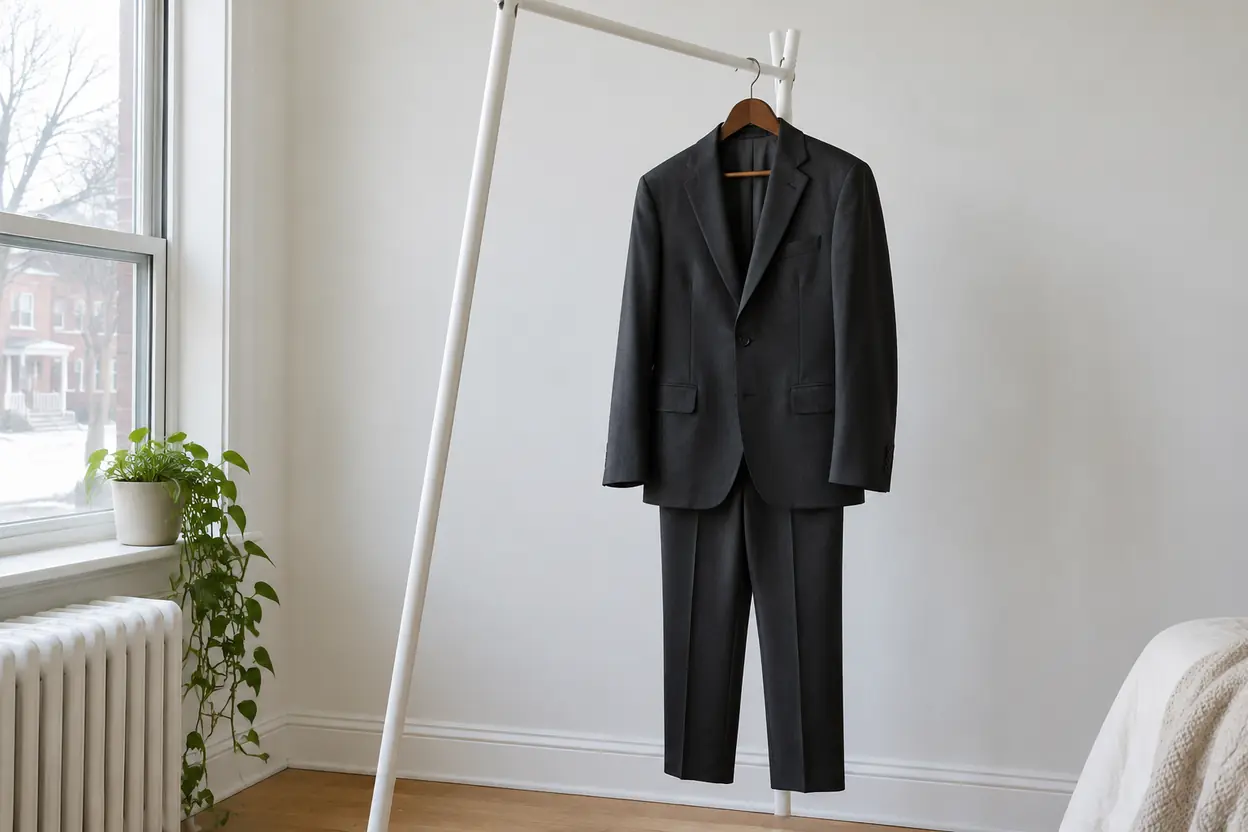
The short list: suits, structured dresses, and formalwear should not go into a standard pickup bag. These items need dry cleaning rather than a wash cycle, and the agitation of a drum can damage their construction in a single run. If you want them collected at the same time as your regular laundry, bag them separately and mark them clearly. They will be routed to the right process, but they need to be identifiable at intake rather than discovered mid-sort.
Items that explicitly say "professional clean only" on their care label fall into the same category. That label exists because the manufacturer tested the fabric and determined that water, detergent, or tumble drying would damage it. We respect those labels even when the owner does not, because replacing a ruined garment is worse for everyone than routing it correctly in the first place.
Pet bedding requires a special-handling flag. Dog beds, cat blankets, and anything that carries animal hair in significant volume needs to be washed separately from human clothing to prevent cross-contamination. If you include pet items without flagging them, we will catch them at intake and process them on a separate cycle, but noting it in advance saves the back-and-forth and keeps your order on its standard 48-hour timeline.
Items with broken zippers or torn seams are worth fixing before they enter the wash. A broken zipper in a drum can snag other garments in the same load. A small tear becomes a large tear under agitation. If you cannot fix it yourself, leave it out of the bag and handle it separately. We are a laundry service, not a tailor, and sending damaged items through a wash cycle tends to make the damage worse rather than better.
Items that are still wet from a previous wash should never be sealed into a bag with dry laundry. We covered this in the sorting section, but it bears repeating here because it is an especially common mistake in summer, when people try to bag damp swimwear or gym clothes. A wet item in a closed bag creates mildew conditions within hours. Either air-dry it first or isolate it in a sealed plastic bag inside the main bag.
When in doubt, leave it out
If you are unsure whether an item belongs in a standard wash cycle, the safest move is to leave it out of the bag and mention it in your booking notes. We can advise on handling before the next pickup, which is faster and cheaper than discovering a problem after the wash has already run. A quick question costs nothing. A damaged garment costs a replacement.
Beyond the specific items above, a useful mental test is this: if you would hesitate to put it in your own washing machine at home, it probably does not belong in the pickup bag without a note. That hesitation is your instinct recognising that the item needs a different process, and the note is how you tell us which process that should be. The system is built to handle exceptions gracefully, but only if it knows about them before the drum starts spinning.
For items that fall into the grey zone between standard wash and professional cleaning, our posts on delicate items care and fabric care notes cover the specifics of what survives a machine cycle and what does not. Reading those once gives you a permanent mental filter for future bags, and most people find that their grey zone shrinks considerably after the first few orders as they learn which of their clothes are genuinely hardy and which need gentler handling.
Real bagging examples from Ottawa households
Every household generates a different kind of laundry bag, and seeing how other people handle theirs can be more useful than a generic checklist. These are composites drawn from real Ottawa customers, anonymised but representative of the patterns our intake team sees every week.
A two-person household in Centretown with no children typically produces one medium bag per week. The contents are mostly work clothing: button-downs, slacks, a few pairs of jeans, underwear, socks, and one or two hand towels. Their prep routine is minimal because the load is uniform and nothing requires special handling. They check pockets on Sunday evening, turn their dark jeans inside out, drop everything into a single canvas bag, and leave it by the apartment door before bed. Total prep time is about five minutes because there are no edge cases to manage. Their standing note says "warm wash for the white shirts, cold for everything else," and that note has not changed in six months.
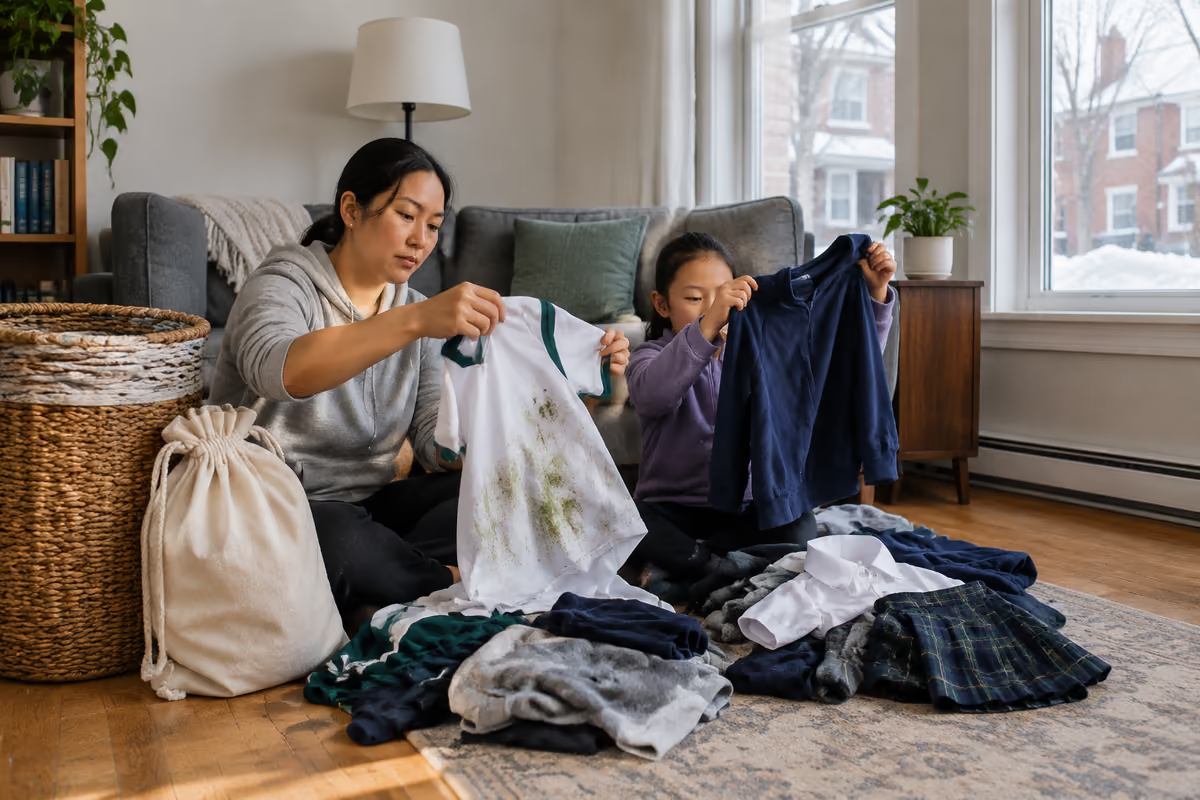
A family of four in Barrhaven tells a different story. Their weekly bag is large and varied: children's school uniforms, sports jerseys with grass stains, bedding from two kids who rotate their sheets weekly, adult workwear, gym clothes, and the occasional stuffed animal that went through a muddy puddle. Their prep takes closer to fifteen minutes because they run through a sorting step that separates the kids' stained items from the adults' everyday clothing. The stained pieces go into a clear plastic bag inside the main bag with a sticky note listing which stains are fresh and which are old. Bedding goes into its own second bag because the volume would otherwise crowd everything else. Their access note mentions that the bag sits inside the garage, door code included, because mornings are too chaotic to coordinate a handoff at the front door.
A single professional in the Glebe working from home produces smaller, less frequent loads. Their pickup is biweekly rather than weekly, and the bag is mostly casual clothing: t-shirts, loungewear, towels, and bedding every other cycle. Their prep is the simplest of the three examples because there are no stains to treat, no special-handling items, and no children's clothing to sort. They bag everything together, leave it on the covered porch, and their only standing note is "no fabric softener on the towels." The entire process takes them under three minutes because the load is predictable and the routine has not changed since their second order.
What these examples share is not a single method but a common principle: each household figured out a prep routine that matches the complexity of their laundry. The two-person household does not need a sorting step because their load is uniform. The family of four needs one because their load is varied. The single professional barely needs a routine at all because their volume is low and their items are forgiving. Your own routine will settle into a similar groove after two or three pickups, shaped by what you actually wear and how often you generate laundry rather than by a one-size-fits-all prescription. Nobody rearranged their evening to accommodate laundry prep. They found the moment that was already empty, the pause that already existed, and attached the habit there. That is why the routine sticks after the first few orders: it never felt like a new task in the first place.
Seasonal prep tips for Ottawa weather
Ottawa's climate swings between extremes, and each season creates different prep considerations that are worth knowing before you bag. None of these are dramatic changes to your routine. They are small adjustments that account for the realities of living in a city where January mornings hit minus twenty-five and July afternoons push above thirty-five with humidity.
In winter, the biggest prep factor is bulk. Sweaters, flannels, heavy socks, and thermal layers take up more bag space than summer clothing, so your bag fills faster even if you are wearing fewer total items. If you find your regular bag is overflowing by mid-January, splitting into two bags is perfectly fine. The second consideration is moisture: snow tracked onto clothing near the door can dampen the outside of your bag if it sits on the floor near boots and wet outerwear. Elevating the bag onto a chair or shelf near the door keeps it dry between when you set it down at night and when it gets collected in the morning.
Spring in Ottawa means mud season, particularly in neighbourhoods near the canal or the river where yards stay soft well into May. Grass stains and mud splashes show up on children's clothing and on the cuffs of adult trousers with regularity. Pre-treating these before bagging makes a measurable difference because mud that dries into fabric bonds with the fibres and becomes harder to lift in a standard wash. A quick rinse under cold water to remove the surface layer, followed by a dab of stain remover, is enough to keep things manageable.
Summer brings two prep challenges that people underestimate: sweat and volume. Lighter clothing means more individual pieces per week, and workout gear or clothes worn during Ottawa's humid July days carry more perspiration than winter layers. Bagging sweaty clothes quickly after wearing them, rather than letting them sit in a hamper for days, prevents odour from setting into the fabric permanently. If you exercise daily and generate gym clothes faster than your weekly pickup cycle can handle, consider a mid-week drop-off or a twice-weekly schedule during the hotter months.
Fall is the easiest season for prep because the weather is moderate, the clothing is layered but not bulky, and there are fewer moisture or stain issues than in any other quarter. The one fall-specific note is that transitional wardrobes mean you might be mixing lightweight summer pieces with heavier autumn layers in the same bag. Placing the heavier items at the bottom still applies, and if you are sending both linen shirts and wool cardigans in one load, a note flagging which items should skip the dryer ensures nothing shrinks unexpectedly.
Beyond the seasonal basics, a few Ottawa-specific details are worth noting. Salt stains from sidewalk treatments are common from November through March; a quick note in your booking that says "salt on trouser hems" ensures those areas get treated before the wash rather than after, when the white residue has already set into the weave. In spring, allergens peak during April and May, and anyone with pollen sensitivity benefits from noting "hot wash for bedding" so sheets come back free of the fine yellow dust that settles on everything left near an open window. Summer at Mooney's Bay or Britannia Beach means sunscreen residue on collars and necklines that standard cold wash does not always lift on the first pass. A note flagging sunscreen stains ensures we use the right pre-treatment.
Brush salt residue off cuffs and hems before bagging. Let heavy knits fully dry on a rack before they go in. Wool holds moisture in the folds longer than you expect, and that trapped dampness can develop a musty scent within hours in a sealed bag.
Use a mesh insert bag for swimwear or post-workout gear that might still carry moisture. Cotton towels used at the beach should be shaken free of sand before bagging, since sand is abrasive in a drum and can scratch synthetic fabrics in the same load.
Common prep mistakes and how to avoid them
The same handful of preparation mistakes tends to repeat across different households, seasons, and bag sizes. None of them are catastrophic. All of them are avoidable with a moment of attention. Here are the ones that come up most often, along with the simple fix for each.
Overstuffing the bag is the easiest mistake to make, especially on a weekly schedule when everything goes into a single collection. An overstuffed bag is harder for us to carry without dragging, harder to sort at intake because items are compressed together, and more likely to have wrinkles set into fabrics that spent hours pressed against each other. If your bag is so full that you cannot close it comfortably, split into two. There is no penalty for multiple bags on the same pickup, and your clothes arrive in better condition when they have room to breathe.
Forgetting to check jacket pockets is surprisingly common even among people who diligently empty trouser pockets. Jackets hang by the door and get tossed into the bag at the last moment without the same pocket-check habit that trousers receive. Yet jacket pockets are where people store keys, transit cards, earbuds, and gloves. A quick pat-down of every jacket pocket before it enters the bag takes five seconds and prevents the kind of loss that requires a phone call to sort out.
Mixing household items with personal clothing happens more often than you might expect. Dish towels, cleaning rags, and kitchen cloths sometimes end up in the laundry bag because they were sitting near the hamper. These items carry grease, food residue, and cleaning-product residue that can transfer to clothing during transit even before the wash cycle begins. Keeping a separate bin for household textiles, even if it is just a small basket in the kitchen, prevents them from wandering into your pickup bag by accident.
Not communicating changes to your pickup spot catches people off guard, particularly in apartment buildings where lobby access or concierge schedules shift. If your building changes its front-door code, or you decide to move your bag from inside the lobby to outside your unit door, updating your notes before the next pickup ensures we find it without delay. A pickup that goes smoothly depends on the bag being exactly where we expect it, and a ten-second note update is far easier than a missed-collection rescheduling.
Bagging items that are still warm from a home dryer is a subtle mistake. If you ran a partial load at home and then decided to send the rest out with your pickup, the warm items can create condensation inside a sealed bag as they cool. That moisture behaves the same way a damp gym shirt does: it creates conditions for mildew. Let home-dried items cool to room temperature before they go into the pickup bag, or leave the bag unsealed until morning to allow air circulation.
Leaving items inside pillowcases or duvet covers catches people by surprise. A sock or a pair of underwear trapped inside a pillowcase during home use often stays trapped when the pillowcase goes into the pickup bag. At intake, we shake out every piece, but items hidden inside folded bedding occasionally make it through to the wash still bundled, which means they do not get properly cleaned. Before bagging bedding, give each piece a quick shake to dislodge anything hiding inside. It takes seconds and prevents the "where did my sock go" mystery that otherwise surfaces at delivery.
Leaving items balled up rather than loosely placed is a subtle mistake that affects wash quality. A sock balled inside itself does not unroll reliably in a wash cycle, which means the inside stays unwashed. A shirt crumpled into a tight wad develops compression creases that require extra heat to release during drying. You do not need to fold items neatly for pickup, but shaking each piece loose before it goes into the bag ensures that water and detergent can reach every surface during the cycle. Loose is the word: not folded, not balled, just open and relaxed.
Finally, inconsistent bag placement catches people more often than they expect. If your building changed its buzzer code, if you moved the bag from the porch to inside the screen door, or if there is construction blocking the usual entrance, a quick note in the app saves the driver a phone call and keeps your order on its scheduled timeline. Access notes that were accurate last month might not be accurate today, especially in Ottawa where winter construction pauses resume in spring and buildings update security systems without much warning. Consistency is the simplest version of this: same spot every time, no surprises, no messages back and forth.
Your prep routine, summarised
Everything above distils into a rhythm that most people internalise within two or three pickups. The first time you prep a bag, you are consciously running through steps. By the fourth or fifth pickup, you are doing it on autopilot while half-watching something on your phone. That progression from deliberate effort to background habit is the entire point of having a system rather than winging it each time.
Your routine, reduced to its simplest form, looks like this: empty pockets, separate anything that needs a different process, pre-treat fresh stains, bag heavy items first with lighter items on top, and place the bag where you said it would be. Five actions, ten minutes, no surprises at pickup. If you add care notes, they stay on your account permanently, so even that step disappears after the first order.
The payoff is not dramatic. It is quiet. It is the absence of problems: no follow-up messages, no items routed incorrectly, no stains that set deeper than they needed to, no bags that toppled in the hallway and spilled into the corridor. Smooth pickups are invisible by design. You put the bag down, you leave for your day, and the next time you think about laundry is when it comes back clean, folded, and ready to put away. That is the entire promise, and ten minutes of evening prep is what makes it reliable week after week.
Ready To Book
Hand off the laundry in under two minutes.

Reader handoffCopy, email, print, or return to the archive.
Share or save
Send this Ottawa laundry guide to someone who needs it.
Share the ottawa laundry guide with a roommate, property contact, or teammate before pickup notes get messy. The controls stay local to this page: no tracking widgets, no third-party script, just practical laundry tips Ottawa readers can pass along.
Services that pair with this guide
Services that pair with this guide.
Use the related services below when these laundry tips Ottawa readers need to turn a tips note into a pickup, a wash and fold order, or a question about specialty handling.
Related services


Related laundry searches.
Ottawa laundry guides continue from a real service page. Every search below lands on a live route.

Done reading?
Use the guide, then hand off the laundry.
This guide should leave you with a clearer next step. Book a pickup when the load fits standard laundry, or contact us when care labels, volume, bedding, or business needs deserve review first.