Commercial Towel Laundry for Small Businesses Ottawa
How commercial towel laundry works for Ottawa gyms, salons, spas, and restaurants: volume pricing, pickup frequency, hygiene standards, no contract.
- Duong Quan Nguyen
- Updated July 15, 2026
- 21 min read
Read the guide
Keep the guide open while the Laundryless route stays clear.
Use the 9 jump links to move through this commercial article without losing your place. On wider screens the dispatch rail stays beside the Ottawa laundry guide while the body keeps the original blog typography.
Commercial
Quick answer
A commercial towel service collects soiled towels from your gym, salon, spa, or restaurant on a set schedule and brings them back clean and folded. Commercial items are priced per item at published prices, with no monthly contract, and you can pause or skip any pickup.
A twenty-member gym goes through sixty towels a day. A salon uses thirty. A spa with six treatment rooms can burn through forty before lunch. That is not a laundry chore; that is a logistics problem, and it belongs to a system rather than a staff member with a key to the basement machine. If you run a small business in Ottawa that relies on fresh towels every morning, this guide explains how commercial laundry service works at towel-scale volume, what it costs, how the pickup schedule fits your week, and why no long-term contract is required to get started.
The volume reality for Ottawa businesses
300+
towels per week for a typical Ottawa fitness studio
Running a small business that depends on towels means confronting an arithmetic problem that compounds quickly. A boutique gym with twenty active members uses roughly sixty towels a day across classes, showers, and equipment wipe-downs. Scale that across a six-day operating week and the number lands above three hundred. A salon with eight chairs runs slightly lower, perhaps two hundred per week, but the towels pick up hair dye, bleach residue, and styling product that make every load harder to clean than a plain gym towel. A spa adds another layer: oils, lotions, and the expectation of flawless white presentation on every treatment table.
The numbers vary by trade, but the underlying pattern does not. Once your weekly towel count exceeds what a single domestic washer and dryer can clear overnight, you have crossed a threshold where the laundry is no longer a chore that fits between closing and going home. It becomes a second job that demands its own staff time, its own machine capacity, and its own maintenance budget. Most small-business owners in Ottawa hit that threshold sooner than they expect, usually within the first year of operation, when the client base grows but the laundry equipment stays the same size it was on day one.
The in-house machine that handled thirty towels a day when you opened is not designed for three hundred a week at sustained pace. Domestic-grade washers overheat, bearings wear, and cycle times stretch when the drum is loaded to capacity every single run. The electricity bill creeps up because you are running six or seven loads a day instead of two, and the water consumption follows the same curve. None of this shows up as a single dramatic failure. It arrives as a slow grind: towels that come out slightly damp because you rushed the dryer, a faint mildew note that clients notice before you do, and a staff member who spends two hours a day feeding machines instead of serving customers.
That slow grind is the signal most owners recognise only in retrospect. They solve the symptom repeatedly, buying a second machine, hiring a part-timer to handle loads, switching to thinner towels that dry faster, without asking whether the problem is structural rather than incremental. A commercial towel laundry service exists precisely at that structural threshold. It replaces the in-house loop entirely: dirty towels leave on a scheduled pickup, clean towels return on the same schedule, and the space, electricity, water, and labour that the machines consumed become available for something that actually earns revenue.
Business types we serve
Fitness studios and gyms
Shower towels, equipment wipe-downs, and class-use hand towels at high daily volume.
Hair salons
Colour-stained towels, cape liners, and hot towels that need consistent bleach-safe processing.
Spas and massage clinics
Oil-saturated sheets and face towels requiring gentle but thorough degreasing.
Restaurants and cafes
Bar towels, kitchen cloths, and server aprons cycled multiple times per shift.
Barbershops
Hot towels for shaves, cape towels, and neck strips in a tight rotation between clients.
Yoga and pilates studios
Sweat towels and mat covers laundered between every class for member confidence.
Each of these trades has a different relationship with towels, and the differences matter when it comes to laundering. A gym towel is typically plain white cotton, designed to absorb sweat and withstand aggressive wash temperatures. The primary concern is odour control and bacterial reduction, because towels that smell clean but harbour bacteria will eventually produce complaints from members who develop skin irritation. Volume is the defining challenge for fitness businesses: even a small studio with fifteen members per class and four classes a day can cycle through two hundred towels before the evening wind-down.
Salons face a different problem entirely. Their towels absorb hair dye, bleach, toner, and styling products that bond chemically with cotton fibres. A standard warm wash does not break those bonds, which is why salon owners often find their towels staining permanently within weeks of purchase. Commercial laundering at higher temperatures with specialised detergents extends towel life significantly and keeps the colour consistent enough that clients are not wiping their face with a visibly stained cloth. The volume is lower than a gym, but the per-towel processing effort is higher.
Spas and massage clinics sit at the intersection of volume and delicacy. Treatment-room towels absorb essential oils, massage lotions, and body butters that leave a greasy residue domestic machines struggle to clear completely. If the residue builds up across washes, the towels lose absorbency and develop a faintly rancid scent that undermines the calm atmosphere spas depend on. Commercial processing with pre-soak cycles and degreasing agents solves this at the root rather than masking it with fragrance.
Restaurants use towels differently again. Bar towels cycle every few hours, kitchen cloths rotate with each prep task, and server aprons accumulate food splatter across a full shift. The hygiene bar here is set by Ontario health regulations rather than client preference, which means the wash temperature and sanitising step are not optional upgrades but baseline requirements. A commercial laundry service that meets those requirements by default saves the restaurant owner from having to prove compliance with an in-house process that inspectors may or may not trust.
Barbershops rely on hot towels as part of the shaving ritual, which means the towels must emerge not only clean but soft enough to press against freshly shaved skin without irritation. The rotation is tight: a busy shop with three chairs can go through forty hot towels in a single Saturday. Yoga and pilates studios face a gentler version of the gym problem, lower per-class volume but a higher expectation of freshness, since members place the towel directly on their face during floor work.
How commercial towel service works
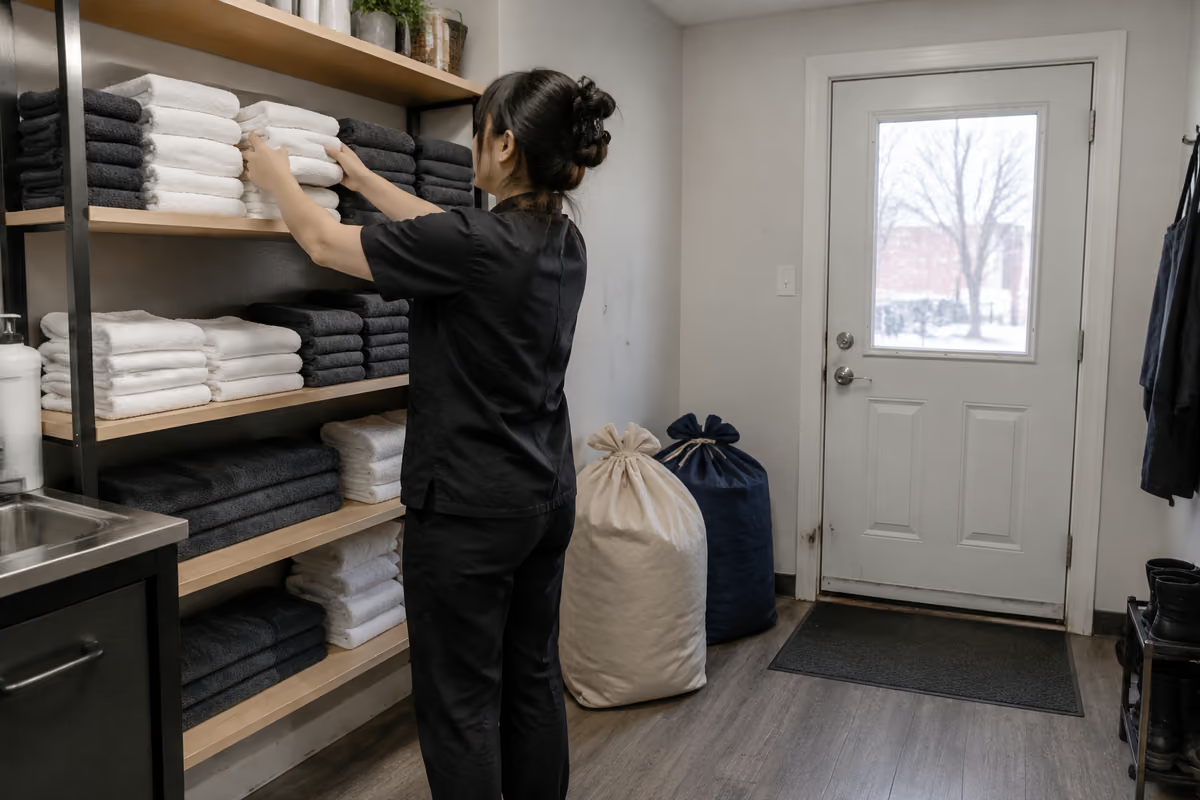
The model is straightforward once you see it in motion. You accumulate dirty towels in labelled bins or bags on your premises. On your scheduled pickup day, we collect those bags, transport them to our facility, wash them at commercial temperatures with appropriate detergents, dry them thoroughly, fold them to a consistent standard, and return them on the next scheduled delivery. The turnaround is built into the rhythm so that you always have a clean supply on hand without maintaining a massive surplus.
There is no minimum contract term. You can start with a single pickup to test the process before committing to a recurring schedule, and you can pause or stop at any point without a cancellation fee. This flexibility matters for seasonal businesses, studios that close for a renovation week, or restaurants that scale down between tourist seasons. The service adapts to your volume rather than locking you into a fixed commitment that penalises natural fluctuation.
The pickup itself takes minutes. Our driver collects the bagged dirty towels from your agreed location, whether that is a back hallway, a supply closet entrance, or a front desk handoff, and leaves the previous batch of clean folded towels at the same time. This swap model means you never have a gap in supply as long as your schedule frequency matches your consumption rate. A gym burning through three hundred towels a week typically runs a twice-weekly pickup so that each batch covers three or four days of operation. A barbershop with lower volume might find once a week sufficient.
The wash process is where commercial service diverges most from what a domestic machine can do. Commercial drum capacity handles large batches without overcrowding, which is critical for towels because they need space to agitate properly and release embedded soil. Water temperature reaches the sixty-degree-plus threshold required for bacterial kill, and the detergent concentration is calibrated for heavy soil loads rather than the light domestic formulations designed for a handful of shirts. Drying runs at temperatures that ensure the towel core is fully dry, which prevents the musty odour that develops when towels are pulled slightly damp and folded into a stack.
The single-operator model means the same team that picks up your towels is the team that washes, dries, folds, and returns them. There is no handoff to a third-party facility, no subcontracted driver, and no anonymous warehouse where your inventory disappears into a shared batch. If a towel goes missing or a batch arrives folded to a different standard than usual, there is one phone call and one answer, not a chain of ticket escalations. For business owners who have tried larger linen services and found accountability difficult to pin down, this directness tends to be the deciding factor.
Ottawa's climate adds a seasonal texture to the towel cycle that businesses in milder cities do not face. Winter months bring road salt, slush, and wet outerwear into gyms and salons, which means entrance mats and wipe-down towels work harder from November through March. Summer patio season drives restaurant towel use upward as outdoor dining multiplies the number of surfaces servers need to keep clean. A commercial towel service absorbs these seasonal surges without requiring you to buy extra machines or hire additional help for four months of the year. The schedule adjusts, the capacity is already there, and the cost scales proportionally rather than jumping in a step function the way a new machine purchase would.
Volume pricing for towel-heavy businesses
Pricing for commercial towel laundry works on a per-pound basis, the same transparent model used for residential wash and fold orders but applied at a scale that makes the per-unit cost far more approachable when you are processing hundreds of towels each week. The standard rate is $3.19 CAD per pound, and verified businesses in qualifying categories (students, teachers, healthcare workers, and seniors on the residential side; volume commercial accounts on the business side) can access the special rate of $3.10 CAD per pound.
To make the arithmetic tangible, consider a mid-size fitness studio that goes through roughly two hundred standard gym towels per week. A typical gym towel weighs about half a pound when dry, so two hundred towels represent approximately one hundred pounds of laundry per week. At the standard per-pound rate, that weekly volume costs a predictable amount that the business can budget against membership revenue without surprises.
Weekly towel service: 200-towel gym example
- Estimated weight (200 towels at ~0.5 lb each)
- ~100 lb
- Per-pound rate
- $3.19 CAD/lb
- Pickup and delivery (2x per week)
- Included
- Folding to gym-rack standard
- Included
Actual weight varies by towel size and fabric. Final invoice is based on weighed totals, not estimates.
The per-pound model rewards consistency. A business that commits to a recurring weekly schedule benefits from predictable routing on our end, which means the service can sustain the included-pickup-and-delivery structure without needing to charge a separate transport fee. One-time or sporadic orders are still welcome, but the economics are most favourable when you settle into a rhythm that matches your towel consumption cycle.
For businesses with especially high volume, such as a multi-location gym chain or a hotel-adjacent spa processing five hundred or more towels weekly, the commercial laundry service page explains how ongoing volume agreements work. These are set up through a direct conversation rather than a self-serve booking, because at that scale the schedule, logistics, and billing cadence deserve a tailored arrangement. For most single-location small businesses, the standard per-pound rate with a recurring schedule is the simplest and most transparent path.
There is no setup fee, no deposit on towels (we wash yours, not supply ours), and no penalty for adjusting volume up or down as your business seasons shift. The invoice reflects what was weighed that week, and nothing else. For an owner accustomed to the unpredictability of machine repair bills, utility spikes, and the hidden cost of staff time spent on laundry, a single predictable line item often simplifies budgeting considerably.
Weekly pickup schedule
The backbone of any commercial towel service is the schedule. Towels are a consumable in a service business: they leave the shelf clean in the morning and return soiled by close. The gap between those two states needs to be bridged by a reliable loop, and that loop is built around pickup and delivery windows that respect your operating hours rather than interrupt them.
Most towel-heavy businesses land on a twice-per-week rhythm as the natural starting point. That cadence keeps the clean-towel buffer high enough to absorb a busy day without running dry, while avoiding the overhead of daily pickups that smaller operations rarely need. For businesses with higher volume or tighter margins on their towel stock, three-times-per-week or even daily schedules are available. The frequency is adjustable at any time without paperwork, because there is no contract locking you into a cadence that no longer matches your reality.
Monday 7:00 am
First pickup
Soiled towels from the weekend are collected before your first clients arrive.
Wednesday
First delivery
Clean, folded towels returned within the standard 48-hour turnaround, ready for the second half of the week.
Thursday 7:00 am
Second pickup
Mid-week soiled towels collected while the Monday batch covers the shelf.
Friday
Second delivery
With 24-hour rush, clean towels are back on site for the weekend rush.
The early-morning pickup window is deliberate. Most gyms open between five and six in the morning, salons between eight and nine, and restaurants begin prep around ten. Collecting soiled towels at seven means the handoff happens during the quiet window before foot traffic begins, and the return at four lands before the end of the business day so staff can restock shelves without staying late.
If your peak days shift seasonally (a patio restaurant that triples towel use in summer, or a gym that surges in January), the schedule flexes with you. Add a third pickup for your busy season and drop back to two when volume normalizes. That elasticity is one of the practical advantages of a no-contract model: the service adapts to your business cycle rather than billing you for capacity you are not using during a slow month.
For businesses that operate seven days a week and cannot tolerate even a single day without fresh stock, a staggered daily schedule ensures that clean towels arrive every morning regardless of weekend closures on the service side. This is less common for single-location small businesses but worth knowing is available if your operation demands it.
The schedule also accounts for Ottawa's geography. A gym in Kanata and a salon in the Market are both within the service area, but routing efficiency means that businesses in the same corridor often share a pickup window. This clustering keeps drive time short, which is what makes included delivery financially sustainable at published per-pound rates. It also means your pickup time is consistent week after week, which makes staffing the handoff simple: the same person can leave the bags at the same spot at the same time every Monday and Thursday without checking a variable schedule.
In-house washing versus a commercial towel service
At some point, every business owner with a stack of dirty towels asks the same question: would it be cheaper to just buy a machine and do it ourselves? The arithmetic looks simple until you start counting all the costs that hide behind the purchase price. Staff time is the largest invisible expense. Someone has to load, unload, fold, and troubleshoot, and that someone is either being paid to do it or being pulled away from revenue-generating work to handle laundry instead. A salon stylist folding towels between clients is not saving money; they are losing billable hours.
Machine wear is the second hidden cost. A residential washer running at commercial volume burns through its lifespan in roughly two years rather than the eight to ten a household expects. A commercial-grade machine lasts longer but costs several thousand dollars up front, plus maintenance contracts, plus the plumbing and electrical work to install it. When the machine breaks, and every machine eventually breaks, there is no backup unless you own two, which doubles every cost in this paragraph.
Utility costs scale linearly with volume. Hot water for towels, electricity for the dryer, detergent, fabric softener, and the occasional bleach cycle all add up to a monthly line item that is easy to ignore because it is spread across several bills rather than presented as a single invoice. A service consolidates that cost into one predictable number.
| In-house washing | Commercial towel service |
|---|---|
| Staff time: 8-12 hours per week | Zero staff hours on laundry |
| Machine purchase or lease cost | No equipment investment |
| Utility bills increase with volume | Flat per-item or per-pound rate |
| Inconsistent wash temperatures | Controlled 60°C+ sanitizing wash |
| Limited by machine capacity | Scales with your volume week to week |
| No backup when machine fails | Service continues regardless of equipment |
| Towels degrade faster from improper drying | Commercial dryers extend towel lifespan |
Hygiene consistency is the dimension that often tips the decision for health-adjacent businesses like spas, massage clinics, and restaurants subject to inspection. A staff member in a hurry may run a shorter cycle or a cooler temperature to get towels back on the shelf faster, and neither shortcut is visible until an inspector flags it or a client notices an odour. A commercial wash runs at a fixed temperature with commercial-grade sanitizer on every load, and that consistency is built into the process rather than depending on individual diligence.
The scalability question matters most for growing businesses. An in-house machine has a fixed throughput ceiling. Once your towel volume exceeds that ceiling, you either buy a second machine (doubling space, cost, and staff time) or start rationing clean towels, which your clients notice before you do. A service simply absorbs the increase. You go from 150 towels a week to 250, the pickup bags get heavier, and the invoice adjusts. No new equipment, no new floor space, no new maintenance contract.
The honest answer is that in-house washing makes sense only when volume is genuinely low and a staff member already has slack hours with nothing else to do. Once you cross roughly a hundred towels per week, the economics tilt decisively toward a service, and the gap widens with every towel above that line.
There is also a reliability dimension that the pure cost comparison misses. A machine fails on the busiest day of the week, because that is when it is working hardest. When a gym's washer breaks on a Monday morning in January, the busiest month of the year for fitness memberships, there is no quick fix. The repair technician is three days out, the towel stock on the shelf covers one more day at best, and suddenly the front desk is apologizing to members who expected a clean towel after their shower. A service eliminates that single point of failure entirely, because the schedule continues regardless of what happens to any single machine. Your towels arrive clean on Thursday whether our equipment had a perfect week or whether a drum needed replacement on Tuesday. That operational continuity is invisible until the moment it matters, and then it matters enormously.
Hygiene standards for commercial towel laundering
Towels sit against skin. In a gym, that skin is sweating. In a salon, it may be freshly cut or chemically treated. In a spa, a towel wraps around someone who just stepped out of a steam room with every pore open. The hygiene standard for commercial towels is not a luxury preference; it is a public health requirement, and Ontario health regulations set the floor rather than the ceiling.
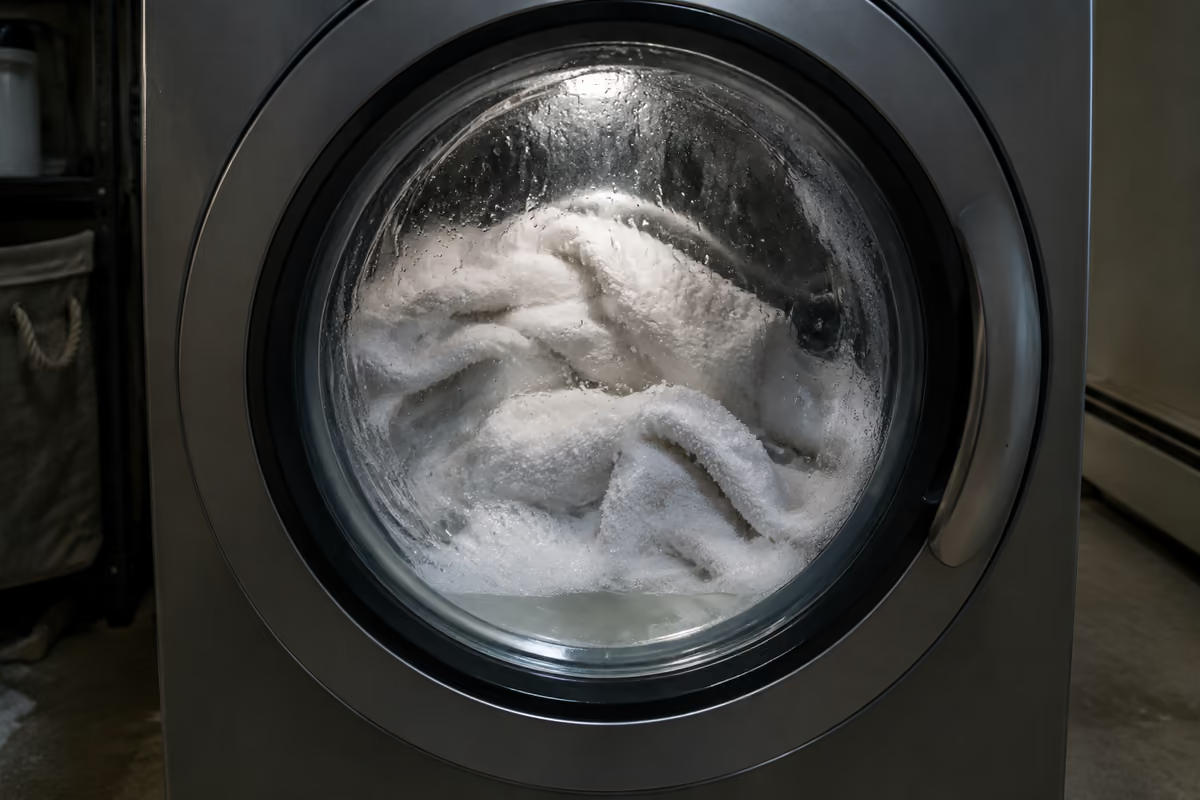
Temperature is the first line of defence. Residential machines typically wash at 30 to 40 degrees Celsius, which is comfortable for clothing but inadequate for killing bacteria that thrive in warm, moist fabric. Commercial towel laundering runs at 60 degrees Celsius or higher, which is the threshold at which most harmful bacteria, fungi, and viruses are reliably eliminated. This is not an optional setting; it is the baseline for every commercial towel load we process.
Detergent matters as much as temperature. Commercial-grade detergent with an integrated sanitizing agent does work that household detergent cannot replicate at any dose. The surfactants are stronger, the enzymes are more targeted, and the sanitizer component is formulated to work at the elevated temperatures rather than being neutralized by them. The result is a towel that is not merely clean-looking but microbiologically safe for the next person who presses it against their face.
Cross-contamination prevention is the dimension that separates a proper commercial laundry operation from a well-intentioned staff member running loads in the back room. Each client's towels are washed as a separate batch. Your gym's towels do not share a drum with the restaurant next door. This separation is maintained from the moment the bag is collected through washing, drying, folding, and bagging for return delivery.
Hygiene standards applied to every commercial towel load
- Wash at 60°C or higher for bacterial and fungal kill
- Commercial-grade detergent with integrated sanitizer
- Separate wash per client to prevent cross-contamination
- Folded in a sanitized environment, not on open surfaces
- Delivered in sealed bags to maintain cleanliness during transport
- Compliance with Ontario health and safety regulations
The folding environment is easy to overlook, but it matters. A towel washed at the correct temperature and dried properly can be recontaminated if it is folded on a surface that has not been cleaned, or stacked in a bin that held dirty laundry an hour earlier. Commercial folding happens in a dedicated clean zone, and finished towels go directly into sealed transport bags rather than sitting exposed while waiting for delivery.
Our Airbnb linen laundry checklist follows similar hygiene standards for short-term rental hosts, because the principle is the same: fabric that touches a stranger's body needs to be verifiably clean, not just visually acceptable.
For businesses subject to health inspections, whether restaurants, spas, or fitness facilities, having a documented external laundry process creates an audit trail that in-house washing cannot easily replicate. The service provides consistent, repeatable results that an inspector can verify, which is simpler than explaining that your staff member usually remembers to set the machine to hot.
Common questions from business owners
Business owners considering a commercial towel service tend to ask the same practical questions. The answers below cover the points that matter most to gyms, salons, spas, and restaurants in Ottawa.
Is there a minimum volume per pickup?
Yes, a per-order minimum applies so that the pickup and delivery trip is worthwhile to run. For most towel-heavy businesses, a single day of operations already exceeds the minimum comfortably. If your volume is very low, a less frequent schedule often makes more financial sense than daily pickups.
Do you supply towels or just wash ours?
We wash towels you already own. We are a laundry service, not a linen rental company. You keep full control over the brand, colour, and quality of the towels your clients experience, and we handle the cleaning cycle that keeps them in rotation.
What if we need emergency rush service?
A 24-hour rush turnaround is available as a paid surcharge on top of the standard 48-hour window. If a machine breaks down or an unexpectedly busy day depletes your stock, contact us early and we can usually accommodate a rush pickup and return within the existing route.
Can you handle coloured towels for a salon?
Yes. Coloured towels are sorted separately from whites and washed at temperatures that maintain hygiene without accelerating colour fade. Salons that use black towels to hide hair dye staining are a common client type, and we handle those loads routinely.
Do you bleach white towels?
White towels are treated with oxygen-based whitening agents rather than chlorine bleach, which preserves fibre integrity and extends the useful life of the towel. Chlorine bleach whitens aggressively but weakens cotton fibres over repeated washes, which shortens replacement cycles and increases your long-term cost.
What about towels with product residue like hair dye or massage oils?
Product residue is expected in commercial towel loads. Hair dye, massage oils, waxes, and kitchen grease are pre-treated before the main wash cycle. Complete removal depends on the substance and how long it has set, but the treatment prevents residue from transferring to other towels in the same load.
How do we track towel inventory across pickups?
Each pickup is logged with a count of items collected, and each delivery is logged with a count returned. You receive a summary after every cycle. Over time this data reveals loss rates, replacement timing, and whether your current stock is sized correctly for your actual usage pattern.
The questions above cover the most common concerns, but every business has particular circumstances. A barbershop that uses hot towels for shaves has different needs from a yoga studio that provides cold towels after class. If your situation is not addressed here, the fastest path to a clear answer is a direct conversation rather than guessing whether the service can accommodate your specific workflow.
Finding the right commercial towel service in Ottawa
For a small business owner in Ottawa, the decision to outsource towel laundering usually comes down to three factors: reliability, cost predictability, and the absence of a binding contract that locks you in when circumstances change. The right service shows up on time, charges a published rate, handles the hygiene requirements your industry demands, and lets you adjust frequency or pause entirely without penalties.
Laundryless runs commercial towel service across Ottawa for gyms, salons, spas, barbershops, restaurants, and fitness studios. We operate on a no-contract basis, which means your agreement is based on ongoing satisfaction rather than a legal obligation. The pickup schedule is yours to set. The pricing is published before you commit. The hygiene standards meet Ontario health requirements for every load. And because a single operator handles the process from pickup through folding and return, accountability never gets diluted across vendors you have never met.
If your business is spending staff hours on towel laundering, paying utility costs for machines running continuously, or dealing with the frustration of equipment breakdowns during peak periods, a commercial towel service removes those problems from your operations entirely. The time your staff currently spends sorting, loading, transferring, folding, and restocking towels goes back into the work that actually generates revenue for your business.
The path from consideration to first pickup is straightforward. You do not need to sign a multi-year agreement or commit to volumes you cannot predict. You simply set a schedule that matches your current usage, and adjust it as your business grows or as seasonal patterns shift your towel consumption. Many Ottawa businesses start with twice-weekly service and move to three times or daily once they see how much operational capacity the change frees up.
Whether you run a twenty-member boutique gym in Westboro, a hair salon in the Glebe, a day spa in Hintonburg, or a restaurant on Elgin Street, the commercial towel service works the same way. Published rates, scheduled pickups, hygienic processing, and folded towels returned to your door on the agreed day. No contract required to begin, and no penalty if your needs change.
commercial towel laundry Ottawa
Scheduled pickup and delivery for business towels.
gym towel laundry service
Volume handling for fitness studio towel rotation.
salon towel cleaning service
Colour-safe processing for salon towels.
commercial laundry pickup Ottawa
Flexible frequency without contract lock-in.
bulk towel laundry service
High-volume capacity for daily towel needs.
business laundry no contract
Ongoing service based on satisfaction, not obligation.
spa linen service Ottawa
Hygienic processing for spa and wellness towels.
commercial wash and fold
Published per-item rates for predictable budgeting.
restaurant towel laundry
24-hour rush turnaround for food service operations.
Ottawa commercial laundry
Local single-operator service across the city.
fitness studio towel service
Recurring schedule matched to class timetables.
towel service small business
Sized for independent operators, not enterprise chains.
The simplest next step is to reach out through the contact page with your estimated weekly towel volume and preferred pickup days. From there, we confirm the schedule, set the frequency, and your first pickup happens on the agreed day. No paperwork beyond the initial setup, no contract to negotiate, and no commitment beyond the next scheduled pickup.
Most business owners who switch from in-house washing describe the same experience in the first week: the staff member who used to spend two hours a day on laundry suddenly has those hours back, the basement or back room where the machine sat is available for storage or another purpose, and the consistent quality of the returned towels is noticeably higher than what the overworked domestic machine was producing. The transition is not dramatic. It is simply the removal of a problem that was consuming resources without earning anything in return.
Commercial laundry serviceSee the full commercial laundry offering for Ottawa businesses: published per-item pricing, flexible scheduling, and no long-term contract.Ready To Book
Hand off the laundry in under two minutes.

Reader handoffCopy, email, print, or return to the archive.
Share or save
Send this Ottawa laundry guide to someone who needs it.
Share the ottawa laundry guide with a roommate, property contact, or teammate before pickup notes get messy. The controls stay local to this page: no tracking widgets, no third-party script, just practical laundry tips Ottawa readers can pass along.
Services that pair with this guide
Services that pair with this guide.
Use the related services below when these laundry tips Ottawa readers need to turn a commercial note into a pickup, a wash and fold order, or a question about specialty handling.


Related laundry searches.
Ottawa laundry guides continue from a real service page. Every search below lands on a live route.

Done reading?
Use the guide, then hand off the laundry.
This guide should leave you with a clearer next step. Book a pickup when the load fits standard laundry, or contact us when care labels, volume, bedding, or business needs deserve review first.