The Airbnb Linen Laundry Checklist for Ottawa Hosts
A complete linen laundry checklist for Ottawa Airbnb hosts: turnover timing, inventory management, stain protocols, guest-ready standards, and service options.
- Duong Quan Nguyen
- Updated May 21, 2026
- 22 min read
Read the guide
Keep the guide open while the Laundryless route stays clear.
Use the 9 jump links to move through this commercial article without losing your place. On wider screens the dispatch rail stays beside the Ottawa laundry guide while the body keeps the original blog typography.
Commercial
Quick answer
Keep three full linen sets per bed: one on the bed, one clean and ready, and one in the wash. At each turnover, strip every bed, collect all towels, pre-treat stains right away, dry everything fully, and count items against your inventory.
A five-star Airbnb review starts with clean sheets. A one-star review starts with a stain the last guest left behind. Between those two outcomes sits a system, and the hosts who run smooth turnovers in Ottawa have usually built that system through trial, error, and a few panicked Saturday mornings with wet linens still in the dryer twenty minutes before check-in.
This guide lays out the full linen management system for Ottawa short-term rental hosts. It covers turnover volume, a step-by-step checklist, day-of timing, stain handling, cost math, the comparison between doing it yourself and handing it off, inventory planning, and guest-ready presentation standards. Whether you run one listing in the Glebe or three in Centretown, the framework applies. If you already use or are considering an Airbnb laundry service, this post shows you exactly what that service replaces and where it fits in your hosting workflow.
The volume reality for Ottawa hosts
Most Ottawa hosts underestimate how quickly linen volume compounds. A single two-bedroom listing with back-to-back weekend bookings generates eight turnovers per month during peak season. Each turnover means stripping and replacing two full bed sets, four to six bath towels, two to four hand towels, a bath mat or two, and a set of kitchen linens. Multiply that across a busy summer month and you are handling somewhere between sixty and eighty individual linen items every four weeks from a single property.
8
turnovers per month for a typical Ottawa 2-bedroom listing
The math shifts further when you factor in Ottawa's seasonal rhythm. Summer brings the highest occupancy, with Canada Day weekend, Bluesfest, and the tail end of tulip season all stacking guests into July. Fall picks up again around the marathon and university move-in. Winter slows for some neighbourhoods but stays strong near Parliament Hill, the Rideau Canal, and ByWard Market. The point is that turnover volume is not constant, and a system that works fine at four turnovers per month can break entirely at ten.
Each turnover is not simply a matter of washing. It is a chain of tasks: stripping, inspecting for stains or damage, sorting by type, washing at the correct temperature, drying fully without overdrying, folding or pressing to a guest-ready standard, and then making beds and staging towels before the next arrival. When you add transit time to and from a laundromat, or the wait for a home machine to finish its cycle, a single turnover can consume two to three hours of hands-on time. At eight turnovers per month, that is sixteen to twenty-four hours spent on linens alone, which is a part-time job that earns nothing on its own.
The volume reality is not meant to discourage you from hosting. It is meant to make the case for building a system before you need one. Hosts who treat linen management as an afterthought tend to discover its weight on the worst possible day: a tight same-day turnover with checkout at eleven and check-in at four, wet sheets in the machine, and a guest messaging to ask if early check-in is possible. A system prevents that morning from ever arriving.
The turnover linen checklist
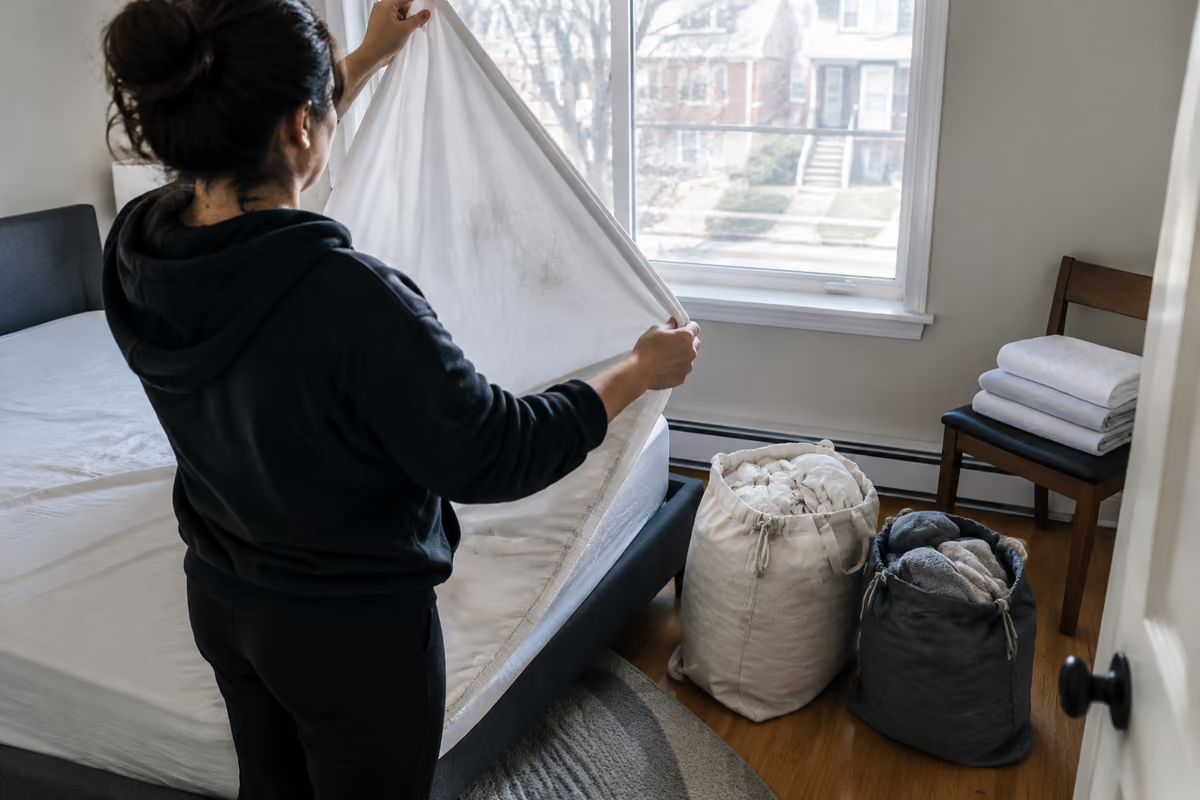
A reliable turnover starts with a checklist you can repeat without thinking. The value of writing it down, even if the steps seem obvious, is that you stop relying on memory during the exact moments when memory is least reliable: the rushed gap between one guest leaving and another arriving. Pin this list to the inside of a closet door at each property, hand it to any cleaner who helps you, and treat it as the minimum standard rather than a stretch goal.
Turnover linen checklist
- Strip all beds: fitted sheet, flat sheet, pillowcases, duvet cover.
- Collect all towels: bath, hand, face cloths, kitchen towels.
- Check every item for stains before bagging.
- Pre-treat visible stains immediately with your kit.
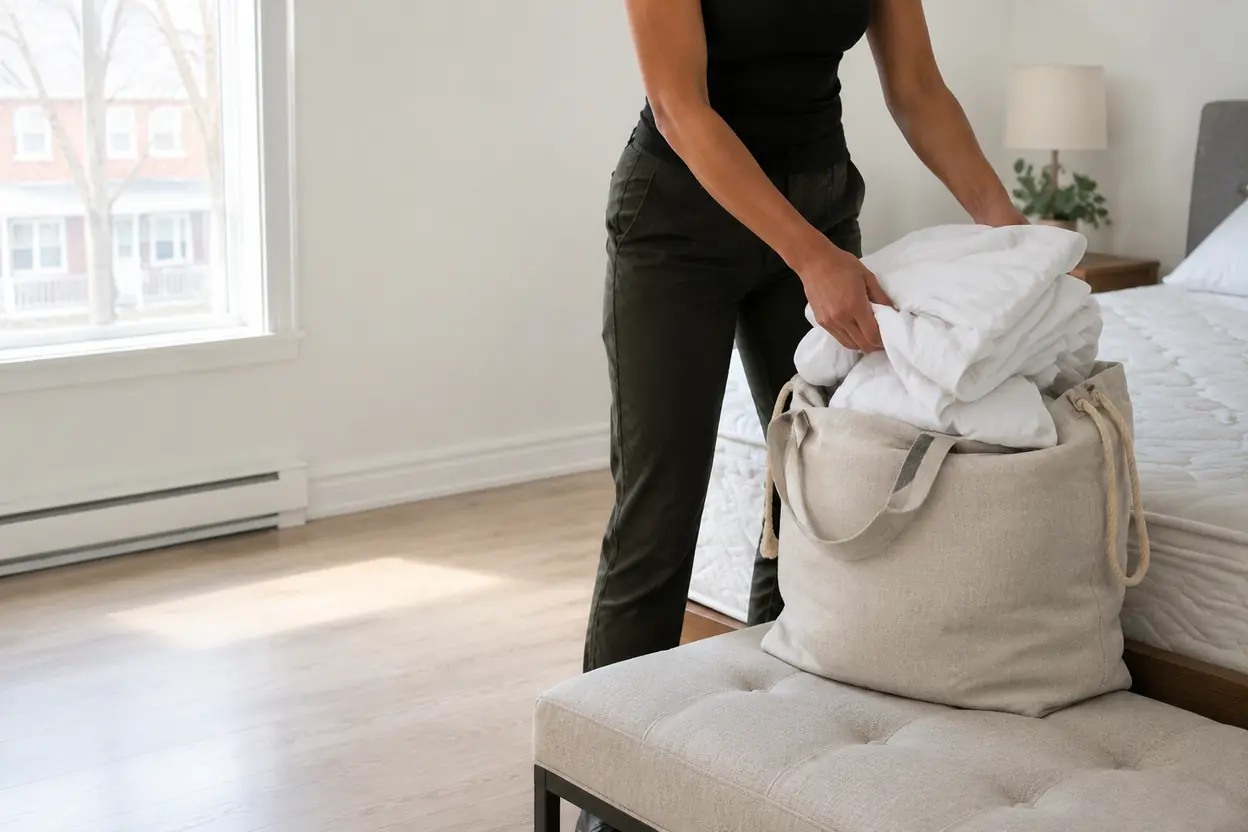
- Bag linens by type: bedding separate from towels.
- Count items against your inventory sheet.
- Note any damaged items for replacement.
- Wash on warm with commercial-grade detergent.
- Dry completely: no damp fold, no shortcuts.
- Iron or press pillowcases and flat sheets.
The order matters more than it appears. Checking for stains before bagging prevents a stain from setting in a warm wash. Separating bedding from towels prevents lint transfer and lets you run each load at its ideal temperature and cycle length. Counting against an inventory sheet catches missing items before the next guest notices a hand towel shortage mid-stay, which is the kind of small failure that lands in reviews far more often than hosts expect.
Pre-treatment deserves particular emphasis because it is the step most hosts skip under time pressure, and it is the step whose absence costs the most. A makeup smear on a white pillowcase is trivial to remove if you catch it within thirty minutes. Left untreated and run through a hot wash, that same smear becomes a permanent shadow that retires the pillowcase. The gap between those two outcomes is about forty-five seconds of attention at step four on this list. Hosting economics are built on small margins, and replacing pillowcases quarterly instead of annually because you skipped pre-treatment is a leak that adds up.
The final two steps, full drying and pressing, are about guest perception as much as hygiene. A duvet cover that went into a bag slightly damp will smell musty by the time it reaches a bed, even if it was perfectly clean. Pressing pillowcases and flat sheets is not decorative. It signals that someone cared enough to finish the job properly, and guests read that signal without consciously noticing it. The hosts with consistently high linen scores in their reviews are not doing anything mysterious. They are completing every step on a list like this one, every turnover, without exception.
If you manage multiple properties across Ottawa, the checklist also serves as a delegation tool. A cleaning assistant or co-host can follow these ten steps independently without needing to call you for guidance, which is the difference between a system that scales and a system that collapses the week you take a vacation.
Turnover-day timeline
Timing is everything on turnover day. The window between checkout and check-in is fixed by your listing settings, and the linen cycle has to fit inside it without spilling over. Most Ottawa hosts set checkout at eleven in the morning and check-in at four in the afternoon, which gives a five-hour window. That sounds generous until you map the actual tasks against the clock and realise how little slack exists for surprises.
11:00 am
Guest checkout
The previous guest leaves. The property is yours to reset.
11:30 am
Strip and bag all linens
Run through the checklist: strip beds, collect towels, inspect for stains, bag by type.
12:00 pm
Pickup collected or wash started
If using a service, the bagged linens are collected from the property. If washing yourself, the first load goes in.
2:30 pm
Fresh spare sets pulled or home wash complete
Clean spare sets come out of the closet while the collected batch is out for its 48-hour wash, or your final dryer cycle finishes.
3:00 pm
Beds made and towels staged
All linens are placed to guest-ready standard. Final walkthrough confirms nothing was missed.
4:00 pm
Guest check-in
The new guest arrives to a fully reset property with fresh linens throughout.
The timeline reveals the pressure point clearly. If you are washing at home with a single residential machine, a two-bedroom turnover requires at least three loads: one for sheets, one for towels, and one for duvet covers or extras. Each load takes roughly forty-five minutes to wash and another fifty to dry, which means running loads back-to-back still pushes you past the three-hour mark. Add folding, bed-making, and the inevitable interruption, a guest messaging about luggage storage, a cleaning supply that ran out, and the five-hour window shrinks to something that feels genuinely tight.
The hosts who manage same-day turnovers reliably have one of two advantages. Either they own enough linen sets to put clean ones on the beds immediately after stripping, pulling from a closet rather than waiting for a machine, or they hand off the wash to a service on a standard 48-hour turnaround, with 24-hour rush when a changeover is tight, and keep a spare set on hand so a clean one is ready while the last batch is out. Both approaches decouple the bed-making step from the wash step, which is the key insight. As long as you are waiting for a dryer before you can make a bed, the timeline owns you rather than the other way around.
For properties in neighbourhoods like Hintonburg, Westboro, or Old Ottawa South where parking is tight and laundromat trips add transit time, the timeline pressure doubles. Driving to a laundromat, loading commercial machines, waiting, folding, driving back, all of that consumes the window even faster than washing at home. The geography of your property matters to the timeline in ways that are easy to overlook until you have lived through a few tight turnovers.
One practical note on early check-in requests, which are common on Ottawa listings during festival weekends. If a guest asks to check in at two instead of four, you lose two hours of buffer. A host whose system depends on the full five-hour window has to refuse. A host whose clean linens are ready by noon, either from a closet stocked with spare sets or from a rush turnaround planned into the week, can say yes without stress. That flexibility shows up in reviews and in the algorithmic boost that Airbnb gives to hosts who accommodate guest requests. The timeline is not just a logistical concern. It is a competitive one.
Stain protocol for hosts
Stains are inevitable in short-term rentals. Guests spill wine, leave makeup on pillowcases, bleed from a shaving nick, drip coffee on kitchen linens, and occasionally leave hair dye on towels that were never meant for that purpose. The question is not whether stains will appear but how quickly and effectively you deal with them when they do. A disciplined stain protocol is the difference between linens that last a year and linens that get retired after three months.
Keep a stain kit at each property
Stock a small bin under the bathroom sink or in the laundry area with: hydrogen peroxide (3%), clear dish soap, white vinegar, a box of baking soda, two clean white cloths, and a spray bottle. Label the bin clearly so any cleaner or co-host can find it without calling you. Replace supplies monthly during peak season.
The thirty-minute rule is the single most important principle. Most common stains, makeup, food, wine, blood, are far easier to lift when treated within half an hour of discovery. After that window, proteins set, pigments bond with fibres, and what was a simple spot becomes a permanent mark. This is why the checklist places stain inspection before bagging: catching it early is the whole game.
Here is how to handle the five most common stains in a rental context. Makeup on white pillowcases responds well to a small amount of dish soap worked into the fabric with a clean cloth, then rinsed with cold water before washing. Red wine lifts with a combination of salt to absorb, then cold water and white vinegar. Blood requires cold water only, never hot, because heat sets the protein permanently. Coffee and tea stains come out with a paste of baking soda and water left for fifteen minutes before a cold rinse. Hair dye on towels is the hardest to treat and is often a replacement decision rather than a treatment one, which is why experienced hosts set out dark towels in the bathroom and keep white towels for the bedroom and kitchen only.
The decision between treating and replacing is not always obvious, and it helps to set a clear threshold. If a stain survives two treatment attempts, replace the item. The cost of a new pillowcase is less than the cost of a guest noticing a faded shadow and mentioning it in a review. White linens are particularly unforgiving because even a faint residual mark is visible against the fabric. Budget a replacement rate into your hosting costs, typically five to ten percent of your linen inventory per quarter, and you will never feel pressured to put a questionable item back into rotation.
For hosts who manage turnovers remotely, the stain protocol also needs to be delegable. Your cleaner needs to know what to treat, what to flag, and what to pull from service. A laminated card next to the stain kit with three bullet points, treat within thirty minutes, cold water for protein stains, flag items with two failed treatments, covers the essentials without requiring a phone call every time something appears.
Comforters and duvets deserve a separate mention because their size makes home treatment difficult and their cost makes replacement painful. A stained duvet insert that cannot be treated with a spot kit should go to a professional service rather than through a home machine, where agitation can spread the stain rather than remove it. If you are managing duvet cleaning alongside your regular linen turnovers, the guide on comforter cleaning frequency covers the cadence and method in detail.
Cost per turnover: DIY vs service
Understanding the true cost of each turnover helps you make a rational decision about where your time is best spent. Most hosts calculate only the direct supply cost, detergent, water, electricity, and arrive at a number that makes DIY look inexpensive. But that calculation ignores the largest input: your time. When you add labour hours at any reasonable value, the picture shifts considerably.
A typical two-bedroom turnover done at home costs roughly four to six dollars in direct supplies: detergent, hot water, electricity for the washer and dryer across three loads. That sounds trivial. Add the two to three hours of active time, stripping, sorting, loading, transferring, folding, pressing, bed-making, and the real cost depends entirely on what you believe your time is worth. At a modest twenty-five dollars per hour, the labour component alone runs fifty to seventy-five dollars per turnover. Most hosts never write this number down, which is how they end up feeling busy without understanding why their hosting margins feel thin.
Cost per turnover: two-bedroom listing
- Detergent and suppliesCommercial-grade detergent, stain kit consumables
- 4 CAD
- Utilities (water, electricity, gas)Three loads: wash and dry cycles
- 3 CAD
- Host time (2.5 hours at 25 CAD/hr)Strip, sort, wash, dry, fold, press, make beds
- 62 CAD
- Linen depreciationReplacement cost spread across useful life
- 8 CAD
Labour valued at 25 CAD/hr. Actual opportunity cost varies by host.
A service-based turnover replaces the labour and utility components with a flat per-set fee. A queen bedding set through our Airbnb laundry service runs at $25.00 CAD, a towel pack at $8.00 CAD, and a kitchen linen pack at $6.00 CAD. For a two-bedroom listing with two queen sets, one towel pack, and one kitchen pack, the service cost per turnover sits around the combined set pricing. Your remaining time cost drops to roughly thirty minutes of bed-making and staging, because the linens arrive clean, dry, and folded.
The break-even point depends on your turnover frequency and how you value your hours. At four turnovers per month, the monthly difference between DIY and service is modest enough that convenience alone justifies the switch for many hosts. At eight or more turnovers per month, the accumulated time savings become significant enough to redirect into guest communication, property improvements, or simply rest. The hosts who scale beyond two properties almost universally use a service, because the labour math at ten-plus turnovers per month makes DIY physically unsustainable for a single person.
One cost that hosts frequently overlook in the DIY calculation is machine wear. Residential washers and dryers are not built for the load frequency that hosting demands. Running three to four loads every few days accelerates bearing wear, heating element fatigue, and drum damage. A replacement washer-dryer pair costs fifteen hundred to three thousand dollars, and hosting-level usage can compress a ten-year appliance lifespan into four or five years. That accelerated depreciation rarely appears in a host's cost spreadsheet, but it belongs there.
DIY vs service: a side-by-side comparison
The decision between handling linen laundry yourself and outsourcing it to a service is not purely financial. It touches time, consistency, scalability, and risk tolerance. Some hosts genuinely enjoy the ritual of washing and folding, and for them the question is not about efficiency but about preference. For others, the question is entirely practical: which option lets them host more properties, accommodate more guests, and maintain higher review scores without burning out.
| DIY linen laundry | Professional linen service |
|---|---|
| Two to three hours per turnover | Thirty minutes of bed-making only |
| Variable cost depending on utility rates | Flat per-set pricing, predictable monthly total |
| Quality depends on your energy that day | Consistent commercial-grade finish every time |
| Limited to one property realistically | Scales to multiple properties without extra hours |
| No backup if your machine breaks down | Service runs regardless of your equipment status |
| Full control over products and process | Preferences noted on account and followed each time |
The time column is where most hosts feel the difference first. Two to three hours per turnover, multiplied across a busy month, is a significant chunk of life spent on a repetitive task. When you are managing one property and enjoy the process, that time might feel acceptable. When you are managing two or three properties, or when turnovers stack on the same day during festival weekends, those hours become the bottleneck that limits your hosting capacity.
Consistency is the second factor that tends to tip the decision. On a good day with energy and focus, your DIY results might match or exceed a service. On a rushed day with back-to-back turnovers, a child who needs attention, or a machine that ran an extra cycle, the quality drops. Guests do not experience your average. They experience the specific turnover that preceded their stay. A service delivers the same result regardless of what else is happening in your life that day, which is why hosts who prioritise review scores tend to migrate toward professional handling once they have experienced a few inconsistent turnovers.
Scalability is the factor that seals the decision for hosts who want to grow. A single person can realistically manage DIY linen laundry for one property, possibly two if the turnovers never overlap. Beyond that, the hours simply do not exist in a day. A service removes the linear relationship between properties and personal hours, which is what makes three, four, or five listings manageable without hiring a full-time assistant.
The backup question is easy to dismiss until it becomes urgent. Residential machines break down, and they tend to do so at inconvenient moments because hosting-level usage accelerates wear. A host without a backup plan faces a same-day scramble: find a laundromat, haul linens across the city, or message the incoming guest about a delay. A host whose linens go through a service never encounters this scenario. The machine that breaks is not their problem. Hosts who use pickup and delivery gain the additional convenience of never having to transport linens themselves, which matters in Ottawa neighbourhoods where parking is limited and laundromats are not always nearby.
The honest summary is that DIY works well for a single property with moderate turnover frequency and a host who has the time and inclination. A service works better for higher frequencies, multiple properties, hosts who value consistency over control, and anyone who has already experienced the stress of a tight turnover with wet linens still in the machine.
Inventory management for short-term rental linens
A checklist only works if the linens exist to fill it. Inventory management is the unglamorous backbone of a smooth turnover system, and the hosts who never scramble are the ones who planned their stock levels before their first guest arrived. The rule is simple: three complete sets per bed, minimum. One set is on the bed, one set is clean and ready in the closet, and one set is in the wash or in transit to a service. That rotation means you are never waiting for a dryer to finish before you can make a bed, which is the exact dependency that makes tight turnovers stressful.
For towels, the ratio is two full sets per guest per night of the maximum occupancy your listing allows. A two-bedroom listing that sleeps four guests needs eight bath towels, eight hand towels, and eight face cloths in active rotation, plus a reserve set for replacements. That sounds like a lot of towels until you experience a full-occupancy weekend booking where every towel in the property is used and you need clean replacements within hours of checkout.
The three-set rule also applies to kitchen linens, though the quantities per set are smaller: two kitchen towels, two dish cloths, and an oven mitt per property is usually sufficient. Kitchen linens see less guest interaction than bath and bed linens, but they still need replacing on every turnover because guests use them in unpredictable ways, from wiping counters to catching spills that would otherwise reach the floor.
Replacement cadence matters as much as initial stock. White linens, which most hosts prefer for their hotel-like appearance and bleach tolerance, show wear faster than coloured alternatives. Plan to replace white sheets every six to twelve months depending on your turnover frequency, and white towels every four to eight months. The timeline accelerates during high-occupancy periods because more turnovers mean more wash cycles, more heat exposure, and more mechanical stress on fibres. A host running eight turnovers per month will retire linens roughly twice as fast as a host running four.
Tracking inventory does not require software or a spreadsheet for most hosts. A simple count taped to the inside of the linen closet door, updated whenever items are added or retired, is enough. The count should list each item type, the number you own, and the date you last replaced any. When the count drops below your three-set minimum for any category, that is your signal to order replacements before the gap becomes a problem during a turnover.
For hosts managing multiple Ottawa properties, centralised inventory becomes more efficient than property-level stock. Keeping a linen reserve at your home or a storage unit, rather than splitting inventory across properties, means you can respond to a surprise shortage at any location without buying emergency replacements at retail markup. The logistics of moving linens between properties is also simplified when you use a commercial laundry service that picks up from and delivers to multiple addresses on a single route.
Guest-ready presentation standards
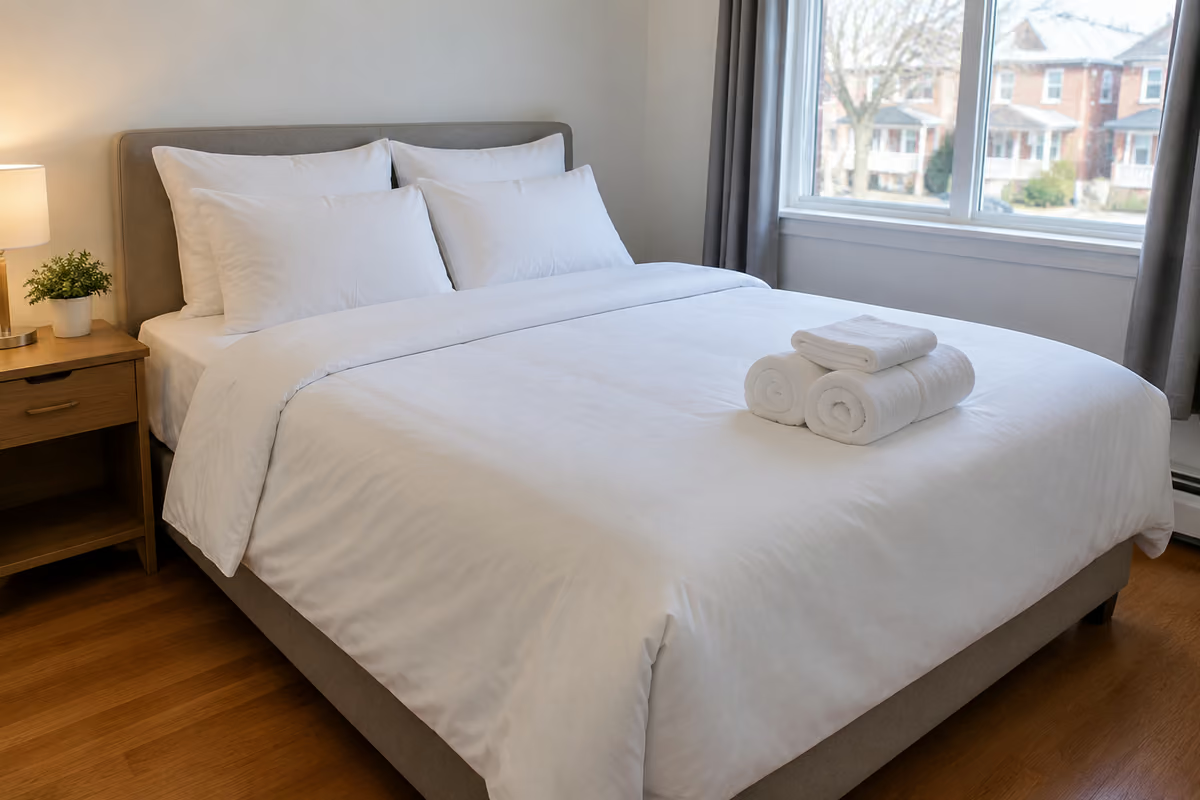
Clean linens are the minimum. Guest-ready linens are the standard that earns five-star reviews consistently. The difference between the two is presentation, and presentation is a set of small, repeatable techniques rather than an innate talent. Every host can learn them, and once learned they add only a few minutes per bed.
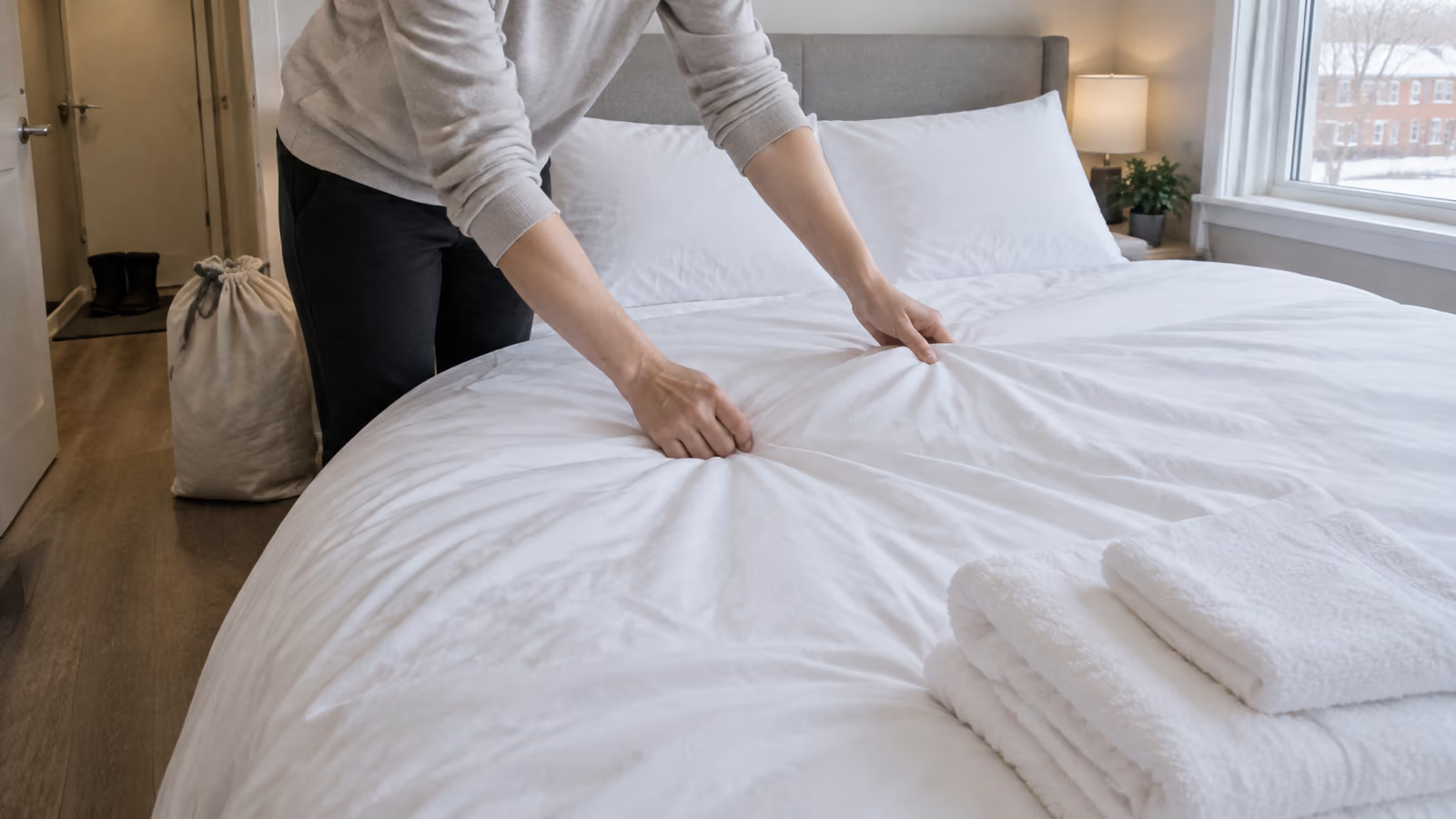
Hospital corners on fitted sheets are the foundation. A properly tucked fitted sheet does not shift during the night, which means the guest wakes up on a smooth surface rather than a bunched mess. The technique takes thirty seconds per corner once you have practised it, and the result is immediately visible when a guest pulls back the duvet. If you prefer a duvet tuck instead, where the duvet is folded down at the top to reveal the flat sheet and pillows, the effect is equally polished and signals the same level of care.
Pillowcases should be wrinkle-free and oriented with the opening facing away from the door. This is a small hotel detail that guests notice subconsciously. A wrinkled pillowcase, even on a perfectly clean pillow, reads as careless. If you press nothing else, press the pillowcases. The flat sheet beneath the duvet benefits from pressing as well, but the pillowcase is the item guests see first and touch first, so it carries the most perceptual weight.
Towel presentation varies by host preference, but the default that photographs well and communicates freshness is a simple fold: bath towels folded in thirds and stacked on a shelf or towel bar, hand towels folded in half and hung on a ring, face cloths folded into squares and placed on the vanity. Rolling towels is an alternative that works for properties with a spa-like aesthetic, but folding is faster and looks equally professional. The key is consistency: every turnover should produce the same arrangement, so guests who return or who browse your listing photos see a match between expectation and reality.
Scent is the final element of guest-ready presentation, and the correct answer for most hosts is no scent at all. Guests have varying sensitivities to fragrance, and a room that smells aggressively of lavender or linen spray will trigger complaints from anyone with allergies or scent sensitivity. Clean linens dried properly should smell like nothing, which is the smell of actual cleanliness rather than a chemical approximation of it. If the property needs freshening between guests, open windows for thirty minutes rather than reaching for a spray bottle. Fresh air is the only scent that offends nobody.
The standard you set in your first few turnovers tends to become the standard your cleaners maintain. If you start with hospital corners, pressed pillowcases, and consistent towel folds, that becomes the baseline. If you start with a rushed arrangement because you were running late, that rushed version becomes the norm. Set the bar during your first month of hosting and it will carry itself forward through every turnover after that.
Airbnb linen laundry
Full turnover linen management for hosts.
Airbnb turnover laundry
48-hour standard wash and return, 24-hour rush.
Airbnb laundry service Ottawa
Local service covering Ottawa postal codes.
short-term rental linen service
Recurring schedule for weekly turnovers.
linen turnover service
Timed to fit your checkout-to-checkin window.
Airbnb linen inventory
Three sets per bed, two towel sets per guest.
guest-ready bedding
Pressed pillowcases, hospital corners, no wrinkles.
Airbnb laundry pickup
Collected from the property, returned clean.
vacation rental linen cleaning
Commercial-grade detergent, proper drying.
Airbnb host laundry tips
Cost math, inventory planning, stain protocol.
short-term rental cleaning Ottawa
Turnover cleaning paired with linen service.
Airbnb cleaning checklist
Ten-step checklist for every turnover.
Building your linen system
The hosts who never scramble are the ones who decided, early, that linen management was a system rather than a chore. A chore is something you do when you remember to. A system is something that runs whether you are paying attention or not. The checklist, timeline, inventory rules, and presentation standards in this guide are the components of that system, and they work together rather than in isolation.
If you are managing one property with moderate turnover frequency, a DIY approach built on the three-set rule and a disciplined checklist will serve you well. The investment is mostly in stock and in the habit of completing every step without shortcuts. If you are managing multiple properties, or if your turnover frequency has climbed past the point where DIY is sustainable without burning evenings and weekends, a linen service removes the labour bottleneck and gives you back the hours that hosting was quietly consuming.
The system you build now will carry you through peak season without the Saturday morning panic that less-prepared hosts know too well. Clean sheets, on time, every turnover, without exception. That is the standard your guests expect, and it is the standard that keeps your reviews where they need to be.
When you are ready to hand off the linen cycle, our Airbnb laundry service handles the wash, dry, fold, and return on a schedule that fits your turnover calendar. You keep making beds and greeting guests. We handle everything between the laundry bag and the linen closet.
Airbnb linen service for Ottawa hostsPer-set turnover pricing, recurring schedules, and 24-hour rush for tight changeovers. Built for short-term rental hosts managing one to five properties.Ready To Book
Hand off the laundry in under two minutes.

Reader handoffCopy, email, print, or return to the archive.
Share or save
Send this Ottawa laundry guide to someone who needs it.
Share the ottawa laundry guide with a roommate, property contact, or teammate before pickup notes get messy. The controls stay local to this page: no tracking widgets, no third-party script, just practical laundry tips Ottawa readers can pass along.
Services that pair with this guide
Services that pair with this guide.
Use the related services below when these laundry tips Ottawa readers need to turn a commercial note into a pickup, a wash and fold order, or a question about specialty handling.
Related services



Related laundry searches.
Ottawa laundry guides continue from a real service page. Every search below lands on a live route.

Done reading?
Use the guide, then hand off the laundry.
This guide should leave you with a clearer next step. Book a pickup when the load fits standard laundry, or contact us when care labels, volume, bedding, or business needs deserve review first.