Laundry Help for Busy Ottawa Families: A Full Guide
How busy Ottawa families manage laundry volume: routines that work, when to outsource, how pickup pricing works for households doing five or more loads a week.
- Duong Quan Nguyen
- Updated June 30, 2026
- 22 min read
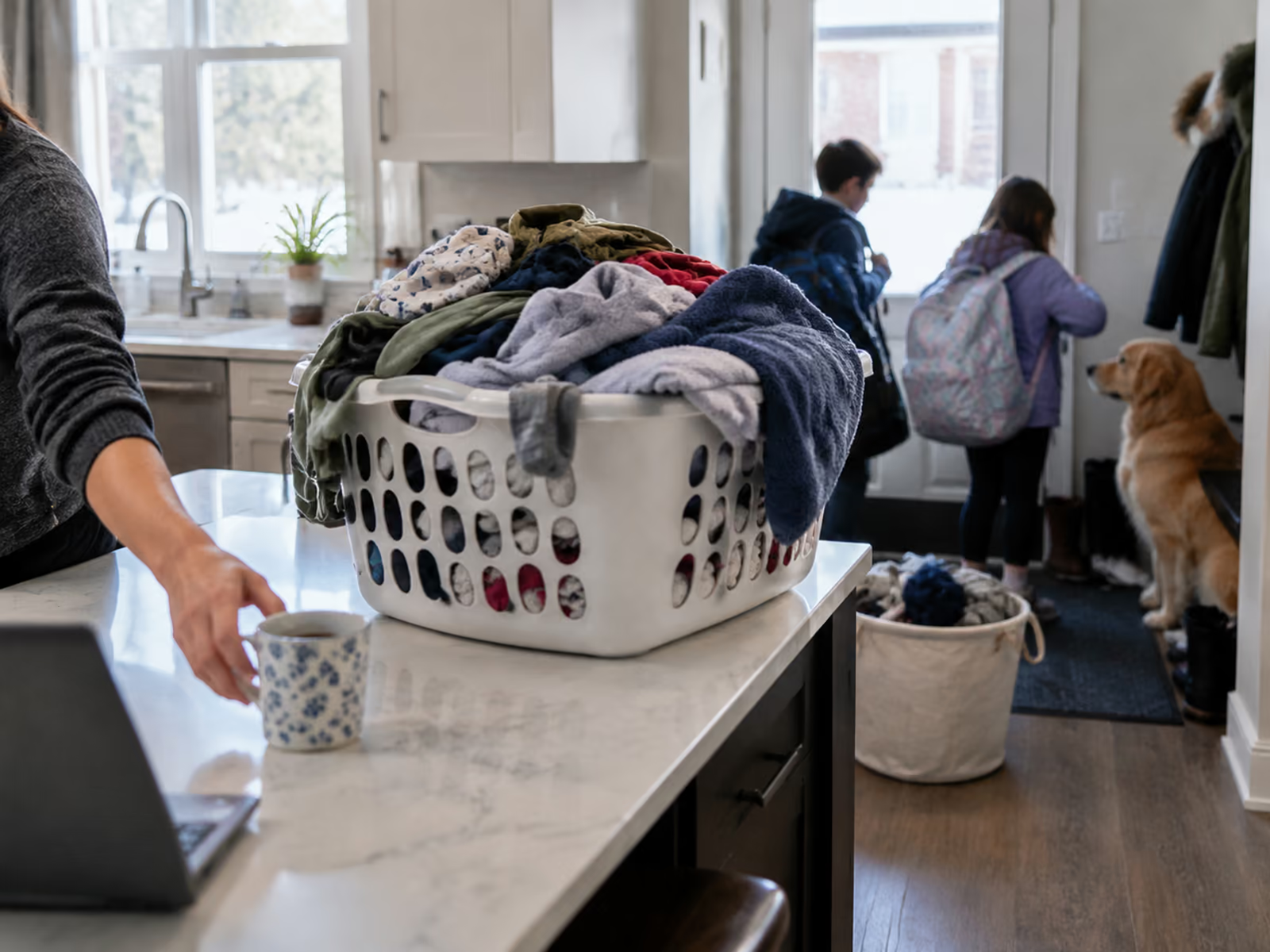
Read the guide
Keep the guide open while the Laundryless route stays clear.
Use the 9 jump links to move through this guides article without losing your place. On wider screens the dispatch rail stays beside the Ottawa laundry guide while the body keeps the original blog typography.
Guides
Quick answer
Busy families keep laundry under control with a set routine, such as one type of load per day, and by handing off the heaviest loads. Our wash and fold is priced by the pound at a published rate, and recurring pickups cost the same as one-time orders.
A family of four generates roughly thirty to forty pounds of laundry every single week. That is not a chore. That is a part-time job running silently in the background of your household, consuming evenings, weekends, and whatever scraps of free time survive the school run. If you are a parent in Ottawa managing two or three kids, a career, and the daily logistics of feeding and transporting small humans, the laundry pile is the thing that never actually ends. You finish one load and another appears, as if the hamper has its own quiet metabolism. This guide is for the families sitting in that exact spot: overwhelmed by volume, short on hours, and wondering whether there is a better way to handle the endless cycle of dirty clothes. We will walk through the real numbers, the routines that actually work, the point at which outsourcing makes honest sense, and how family laundry pickup pricing works for households doing five or more loads a week.
The real volume of family laundry
8-10
hours per week spent on laundry for a family of four
Most parents do not realize how much time laundry actually consumes until they sit down and count. The number surprises people because no single session feels that long. A load takes ten minutes to sort and start, another five to move to the dryer, another fifteen to fold and put away. But multiply that by the seven or eight loads a typical family of four runs per week, and you arrive at a figure that would qualify as a shift at a part-time job. The hours hide because they are scattered: twenty minutes before the school bus, half an hour after dinner, a folding session crammed into a Sunday evening while the kids resist bedtime. Individually each fragment is manageable. Collectively they represent a significant portion of your available free time.
The volume itself is worth understanding in concrete terms, because "a lot of laundry" is vague and vague problems feel unsolvable. A family of four with two school-age children typically generates between thirty and forty pounds of laundry per week. That breaks down roughly as follows: kids' school and play clothes account for about ten to twelve pounds, because children change more often and stain more aggressively than adults. Adult clothing for two working parents adds another eight to ten pounds. Towels, used daily by four people, contribute six to eight pounds on their own. Bedsheets for the household, even on a fortnightly rotation, add another five to eight pounds in the weeks they are due. And then there are the extras that never appear in the mental model: sports uniforms, dance leotards, seasonal jackets, the guest towels after a weekend visit, the kitchen linens that accumulate grease and spills.
When you have a toddler in the house, the numbers climb further. Toddlers produce laundry at a rate that seems physically impossible for a creature that weighs thirty pounds. Between food spills, outdoor play, potty-training accidents, and the sheer number of outfit changes a typical day demands, a single toddler can add five to seven extra pounds per week to the household total. Families with two children under five often find themselves running loads daily rather than batching, which erodes any efficiency a routine might offer.
The point of laying these numbers out is not to overwhelm you further. It is to name the problem honestly so that the solutions that follow can be measured against a real baseline rather than a feeling. Eight to ten hours per week is real time with a real opportunity cost. Whether you choose to reclaim that time through better routines, selective outsourcing, or a combination of both depends on your family's priorities, but the first step is acknowledging that the time exists and that it is yours to spend differently if you choose.
What a family laundry week looks like
The abstract numbers above become more tangible when you map them onto an actual week. Most families who have found a sustainable rhythm do not try to conquer all the laundry in a single marathon session. Instead, they spread the work across the week in predictable chunks, each day carrying a different category. The pattern below is a sample routine for an Ottawa family, built to hold even when the week gets chaotic.
Monday
Kids school and play clothes
The weekend generates a pile. Monday morning is the reset: everything from Saturday and Sunday goes in, plus whatever did not make it into Friday evening laundry.
Wednesday
Towels and bedding
Mid-week is towel day for most families. Bedsheets join on alternate Wednesdays if you rotate fortnightly, or every Wednesday if anyone in the house has allergies.
Friday
Adult work clothes
End of the work week means the dress shirts, blouses, and weekday trousers are ready. Running these separately keeps ironing manageable and prevents kid stains from migrating.
Sunday
Overflow and sports gear
Whatever accumulated during the week that did not fit its assigned day lands here: sports uniforms, dance gear, extra kid changes, and the inevitable mystery items from backpacks.

The reason a distributed schedule works better than a single laundry day is not just about spreading the labour. It is about keeping the pile from becoming psychologically oppressive. A family that batches everything to Sunday faces a morning with six or seven loads stacked ahead of them, and the dread of that mountain often leads to avoidance, which only makes next Sunday worse. By contrast, two loads on Monday and two on Wednesday feel achievable. They fit into the margins of a weekday evening without requiring you to surrender a full weekend morning.
There is a second benefit to spreading the work: it keeps your machines available. Ottawa families who live in condos or apartments with shared laundry rooms know that weekend slots are contested. Everyone in the building has the same idea, and the result is a queue that turns a one-hour task into a two-hour wait. Weekday evenings are almost always open. If you shift your heaviest loads to a Tuesday or Thursday, you avoid the weekend bottleneck entirely, which is a small logistical win that compounds over months.
The schedule above is not prescriptive. Some families run a different arrangement: lights on one day, darks on another, bedding on a third. Others sort by person rather than by category, giving each child their own laundry day so the folding and putting away stays contained. The principle that matters is predictability. When laundry has a fixed slot in the week, it stops being an ambient guilt that follows you through every evening and becomes a task with a beginning and an end. That psychological shift is worth more than any sorting hack, because the real exhaustion of family laundry is not physical. It is the feeling that it is never actually done.
Baby and toddler laundry specifics
Families with infants and toddlers operate in a different laundry universe than households with older children. The volume per pound of child is dramatically higher, the stain variety is more creative, and the care requirements are stricter. If you have a baby under twelve months or a toddler in the thick of potty training, you already know that "doing laundry" has become a daily event rather than a scheduled chore.
Babies produce between three and five outfit changes per day in their first year. Each change is small, a onesie weighs almost nothing, but the frequency adds up. Factor in burp cloths, swaddles, crib sheets that need changing after a nighttime leak, and the bibs that never quite catch everything, and a single infant can add a full extra load to your week. Toddlers are worse in some ways because their clothes are larger, their messes are bigger, and their capacity for finding mud, paint, or food to wear is essentially unlimited.
The care side matters more for baby items than for anything else in the household. Infant skin is reactive in ways adult skin is not, and the detergent that works perfectly well for your jeans can cause rashes, eczema flares, or general irritation on a baby. Fragrance-free, hypoallergenic detergent is not a luxury preference for infant laundry; it is a medical-grade default that paediatricians recommend universally. If your household uses scented detergent for adult clothes, baby items need to be separated and washed on their own cycle with the gentler product. This is one of the reasons family laundry takes more time than the simple pound count suggests: it is not one task but several parallel tracks with different rules.
Fragrance-free for all baby items
Every item that touches your baby's skin, including crib sheets, towels, washcloths, and any blanket used for tummy time or sleep, should be washed with fragrance-free detergent. This is not just about the clothes they wear. Residue from scented detergent on a crib sheet sits against their face for ten to twelve hours a night. If you are outsourcing any part of baby laundry, confirm that the service uses a fragrance-free option for babies by default rather than as an add-on.
Stain treatment is the other area where baby and toddler laundry diverges from the adult version. The stain profile is unique: pureed sweet potato, formula, breast milk, diaper blowouts, and the occasional artistic exploration with markers or paint. Many of these stains are protein-based, which means hot water sets them permanently. The correct first response to most baby stains is a cold rinse followed by an enzyme-based pre-treatment, then a cold wash. Parents who do not know this often discover it the hard way when a favourite onesie comes out of a hot wash with the stain baked in for good. If you are managing baby laundry alongside the rest of the household, same-day pre-treatment is the single habit that saves the most clothing. A stain that sits for twenty-four hours is dramatically harder to lift than one rinsed within the first hour.
The practical implication for family routine is that baby laundry often needs its own mini-schedule layered on top of the household rhythm. Many parents run a small baby-only load every other day, separate from the main household loads, using fragrance-free detergent and cold water exclusively. This keeps the baby items from getting lost in the larger family wash and ensures the care requirements are met without having to think about them each time.
A family laundry routine that works
The families who feel least overwhelmed by laundry are not the ones with the most free time. They are the ones who have built a routine sturdy enough to run on autopilot, even during a bad week. A good family laundry routine removes the decision-making that drains energy. You do not stand in front of the hamper on a Tuesday evening wondering what to wash. You already know, because Tuesday is towel day, or lights day, or whatever category you assigned weeks ago and have not had to reconsider since.
The checklist below captures the principles behind a routine that survives contact with real life. These are not aspirational tips from a magazine. They are the habits that hold up when someone is sick, when the week runs long, and when the laundry room is shared with twelve other units.
Family laundry routine essentials
- Assign one day per category rather than one marathon day
- Sort into hampers by category, not by person
- Pre-treat stains the same day they happen
- Fold immediately after drying to prevent wrinkle pileup
- Involve kids age five and older in folding their own clothes
- Outsource bedding and towels if budget allows
The first item deserves emphasis because it is the single change that makes the largest difference. Families who batch all their laundry to a single day, usually Saturday or Sunday, face an enormous psychological barrier at the start of that session. Seven or eight loads stacked in a row feels punishing before you begin, and the result is often avoidance. The loads do not get done, they roll into the following week, and the pile grows until it becomes genuinely unmanageable. Splitting by category across the week eliminates this. Two loads on a weekday evening is a twenty-minute task, not a day-long project.
Sorting by category rather than by person is the second highest-leverage change. When each family member has their own hamper, you end up running many small loads with mixed fabric types, which is inefficient and often means the machine is half-empty. When you sort by category instead, all towels go in one hamper, all darks in another, all lights in a third. The loads run full, the settings stay consistent, and the sorting step at wash time disappears entirely because it already happened at the hamper. Kids can learn this system by age four or five, which means the sorting labour is distributed rather than sitting entirely on one parent's shoulders.
Pre-treating stains on the same day they happen is a habit that saves more clothing than any detergent choice. A grass stain rinsed in cold water within an hour lifts easily. The same stain left for three days bonds to the fibre and becomes permanent regardless of what product you throw at it. For families with young children, keeping a spray bottle of enzyme-based pre-treater next to the hamper makes this a five-second habit rather than a special project. The parent who notices the stain sprays it immediately and tosses the garment in the hamper. No extra steps, no mental load, no remembering to come back to it later.
Involving children in the folding process is not about getting free labour. It is about teaching the skill incrementally so that by age eight or nine, a child can genuinely own their own laundry from hamper to drawer. Starting at five with simple items, pairing socks, stacking washcloths, folding pyjamas, builds the muscle memory without overwhelming them. The key is making it routine rather than exceptional. When folding happens at the same time every week and includes everyone, it becomes a household rhythm rather than a chore imposed on reluctant participants.
The last item on the checklist bridges into the next section. Outsourcing the bulky, time-consuming categories, bedding and towels in particular, is the most common first step for families who decide that some portion of their laundry time is better spent elsewhere. These items are heavy, they take multiple dryer cycles in a home machine, and they do not require the careful sorting or stain treatment that children's clothes demand. Handing them off to a wash and fold service removes the most physically demanding loads from your week without requiring you to give up control of the items you care about most.
When outsourcing makes sense for families
Not every family needs to outsource laundry, and not every family that could benefit from it is ready to. The decision is personal, shaped by schedule, budget, living situation, and how much mental space the chore currently occupies. But there are patterns. Certain life stages and household configurations make outsourcing not just convenient but genuinely rational, and recognising yourself in one of those patterns is often what moves the idea from "maybe someday" to "this week."
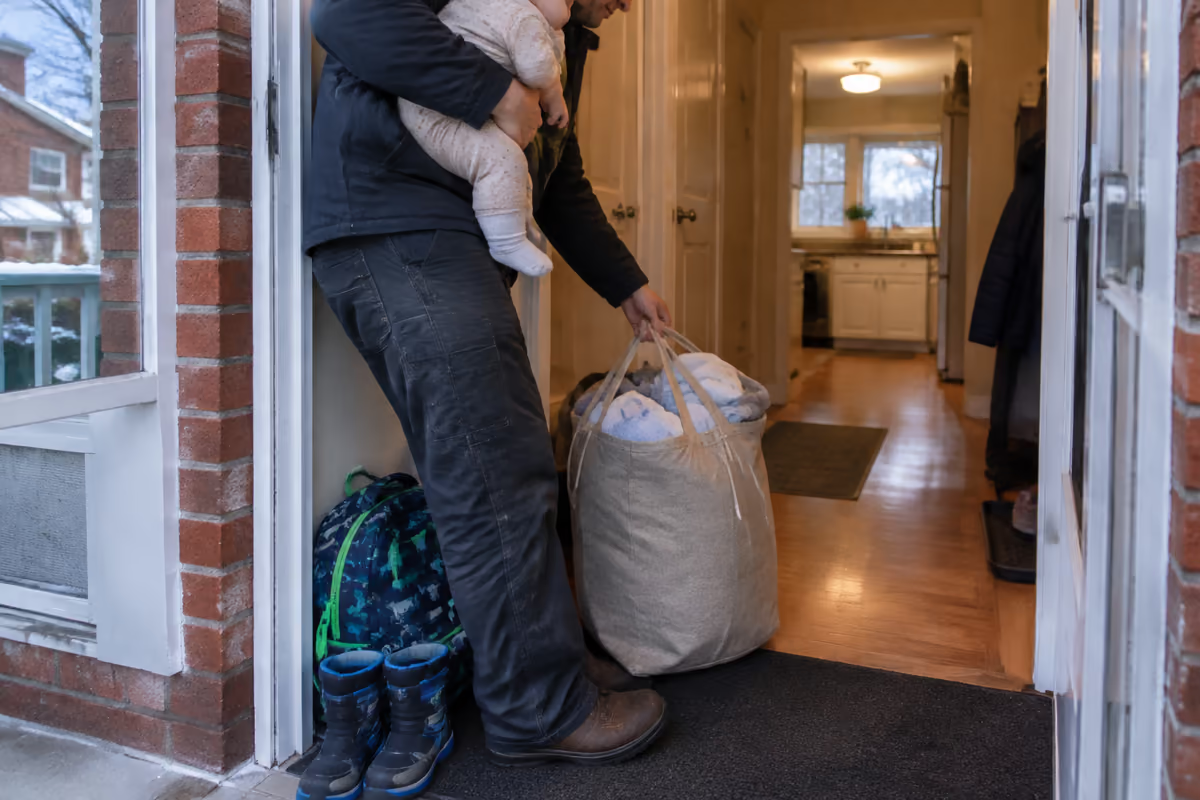
The clearest signal is when both parents work full-time and the household has no stay-at-home capacity during weekday hours. In a dual-income Ottawa family with school-age kids, the window between arriving home and bedtime is roughly three hours. Those hours need to cover dinner, homework help, bath time, and whatever small human crises the evening produces. Laundry that requires an hour of active attention during that window is competing directly against time with your children, and it almost always loses. The loads get pushed to the weekend, the weekend fills with other obligations, and the cycle of perpetual catch-up begins. For these families, outsourcing even the bulkier categories, towels, bedding, and overflow, can reclaim two or three of those evening hours per week.
A new baby in the house is the second strong signal. The first three months with an infant are a period of genuine sleep deprivation, and adding laundry volume to a schedule that barely supports basic self-care is a recipe for burnout. New parents who outsource the adult and household laundry during those early months are not being indulgent. They are making a practical decision about where their limited energy should go. The baby-specific items can still be handled at home with the right detergent and care routine, while the rest of the household's laundry leaves and returns without requiring any parental attention.
Sports-heavy households are a third pattern. A family with two kids in competitive sports, hockey, soccer, swimming, dance, generates a volume of specialised laundry that sits outside the normal household rhythm. Gym bags arrive on unpredictable days, the items inside them need prompt washing to prevent odour setting in, and the sheer weight of towels and uniforms can overwhelm a standard home machine. For these families, a weekly recurring pickup that handles the sports overflow alongside the regular household load keeps the system from breaking down every time tournament season arrives.
The fourth pattern is Ottawa-specific: families living in condos or apartments without in-suite laundry. Shared laundry rooms in buildings add friction that compounds with family volume. You are not just doing seven loads; you are doing seven loads while competing with neighbours for two machines, carrying baskets up and down floors, and monitoring cycles from a distance because leaving clothes unattended means someone moves them. The per-load time penalty of a shared facility easily doubles the total hours spent. For these families, a family laundry pickup service eliminates the facility entirely and returns the clean clothes to their door.
There is also a subtler signal that does not fit neatly into a demographic category: the family where laundry has become a source of household tension. When the chore generates resentment between partners, when it is the thing that starts arguments on Sunday mornings, when one parent carries it entirely while the other does not register the labour, outsourcing can function as a pressure valve. It removes the task from the negotiation entirely, which sometimes matters more than the hours it saves.
The common thread across all these patterns is that outsourcing makes sense when the time and energy cost of doing laundry at home exceeds the financial cost of handing it off. That threshold is different for every family. A single-income household with a tight budget and a parent home during the day has a high threshold. A dual-income family with two kids in sports and no in-suite machines has a low one. The honest way to find your threshold is to track your actual hours for two weeks, multiply by what those hours are worth to you, and compare the result to the monthly cost of a pickup service. For most families who fit the patterns above, the math resolves clearly in favour of outsourcing at least some portion of the weekly load.
Family pickup cost per month
The question most families arrive at eventually is simple: what does this actually cost for a household our size? The answer depends on volume, frequency, and whether you outsource everything or just the categories that drain the most time. Below is a representative breakdown for a family of four that sends two bags per week on a recurring schedule, which is the most common configuration for households in this range.
Monthly family pickup estimate (2 bags per week)
- Week 1: two bags at ~20 lb eachTowels, bedding, and kids overflow
- $127.60 CAD
- Week 2: two bags at ~20 lb eachAdult clothes and household linens
- $127.60 CAD
- Week 3: two bags at ~20 lb eachMid-month standard mix
- $127.60 CAD
- Week 4: two bags at ~20 lb eachEnd-of-month standard mix
- $127.60 CAD
Based on the standard rate of $3.19 CAD per pound with a 15 lb minimum per order, before HST. Recurring schedules use the same rate.
That monthly figure often surprises people in both directions. Some families expected it to be higher, having assumed that any pickup service must be a luxury product priced accordingly. Others expected it to be lower, having not calculated how many pounds their household actually produces. The number itself is less important than the comparison: what does this cost relative to the time it returns?
For a family spending eight to ten hours per week on laundry, outsourcing all of it through a pickup service effectively purchases back thirty-two to forty hours per month. Divide the monthly cost by those hours and you get the per-hour cost of your reclaimed time. For most dual-income Ottawa families, that figure sits well below what either parent earns per hour at work, which makes the trade economically clear even before you factor in the less quantifiable benefits: reduced stress, fewer arguments about chores, and weekends that actually feel like weekends.
The comparison to a laundromat is also worth making explicit. A family using a coin-operated laundromat pays roughly three to five dollars per load for washing and drying, plus the time spent driving, waiting, folding on-site, and driving home. Seven loads per week at four dollars each plus two hours of round-trip time produces a monthly cost that approaches the pickup service cost while still consuming significant hours. The pickup service eliminates the time entirely, which is the point. You are not paying for someone to do what you could do for free. You are paying for the hours you would otherwise spend in a laundromat or a shared building facility.
Families who do not want to outsource everything often start with a partial approach: bedding and towels go to the service, while everyday clothing stays at home. Bulky items like duvets and comforters are especially good candidates because they barely fit in a home machine and take multiple dryer cycles; a dedicated comforter cleaning service handles them properly without monopolising your washer for an entire afternoon. This roughly halves the monthly cost while removing the bulkiest, most time-consuming loads from the household routine. It is a common entry point for families who want to test the value before committing to a full weekly pickup.
The pricing page has the live per-pound rates. The numbers above use the published standard rate, which is the same whether you book once or set a weekly schedule. If you are an eligible teacher or healthcare worker, the lower special rate applies.
What changes after switching
The shift from doing all your own laundry to outsourcing even a portion of it changes the texture of a family's week in ways that are hard to anticipate until you experience them. The biggest change is usually not the clean clothes themselves but the time that reappears. An evening that used to be consumed by sorting and folding is suddenly open. A Sunday morning that was reserved for catching up on the week's overflow is now available for breakfast together, a trip to the park, or simply sitting quietly with a coffee while the kids play.
We got our Sunday mornings back. I did not realise how much resentment I was carrying about laundry until it was gone. Now the kids wake up and we make pancakes instead of sorting socks. It sounds small, but it changed the whole feeling of our weekends.
The emotional weight of laundry is something that rarely gets named explicitly, but parents feel it acutely. It is not just the physical work. It is the ambient awareness that the pile is growing, the guilt of letting it sit, the low-grade dread of facing it after a long day. When that weight lifts, the relief is disproportionate to the task itself. Parents can feel lighter, less irritable, more present with their children in the evenings. The laundry was never going to kill them, but it was quietly eroding the margins of their week, and removing it restored something they did not know they had lost.
Partners often notice the change in each other before they notice it in themselves. When one person in a household has been carrying the laundry load silently, and that load disappears, the tension it was generating becomes visible in its absence. Arguments that seemed to be about other things, dishes, scheduling, who does more, often decrease when the laundry variable is removed from the equation. This is not to suggest that a pickup service solves relationship problems, but it does remove one chronic friction point that many couples underestimate until it is gone.
The new routine also becomes invisible quickly. The first pickup feels unfamiliar. The second feels normal. By the fourth or fifth, the process has faded into the background of the week, no different from the garbage collection or the grocery delivery. The effort required to maintain it is essentially zero: leave a bag, carry on, receive clean clothes. That frictionlessness is deliberate, because a service that requires ongoing attention from an already overwhelmed parent has failed at its basic job.
Tips for reducing family laundry volume
Outsourcing is one lever, but reducing the raw volume of laundry a family generates is another, and the two work well together. Less volume means a smaller pickup and a lower per-pound total, so these habits pay off whether you handle the wash yourself or send it out.
None of these habits eliminate laundry, and they are not meant to. They shrink the pile at the margins so that whatever approach you choose, doing it yourself, sending it out, or a mix, starts from a smaller and more predictable weekly volume. For families sending laundry out, a smaller bag is a lower per-pound total; for families doing it themselves, fewer loads is fewer hours.
Finding the right balance for your household
There is no single right answer for how much laundry a family should outsource, because the right balance depends on how scarce your time is, how tight your budget is, and how much the chore weighs on the household emotionally. A family with two demanding careers and three kids sits in a very different place than a family with one parent at home who finds the routine manageable. The goal is not to outsource everything on principle. It is to find the specific split that buys back the most peace for the least cost.
For most busy Ottawa families, that balance starts partial: bedding, towels, and bulky items go to a laundry pickup and delivery service while everyday clothing stays home, then expands to a full weekly pickup once the value becomes obvious. The pricing page has the live per-pound rates, so you can model the exact monthly figure for your household's volume before committing to anything.
family laundry service Ottawa
laundry help for busy parents
weekly laundry pickup families
family wash and fold cost
kids laundry service
recurring laundry pickup Ottawa
bedding and towel laundry service
scheduled laundry pickup
laundry outsourcing for families
When you are ready to see the exact figure for your family's volume, you can start a booking in a few minutes and the total will be clear before your card is charged.
Laundry pickup and delivery serviceSee the full service details, coverage area, and 48-hour turnaround windows for Ottawa families.Ready To Book
Hand off the laundry in under two minutes.

Reader handoffCopy, email, print, or return to the archive.
Share or save
Send this Ottawa laundry guide to someone who needs it.
Share the ottawa laundry guide with a roommate, property contact, or teammate before pickup notes get messy. The controls stay local to this page: no tracking widgets, no third-party script, just practical laundry tips Ottawa readers can pass along.
Services that pair with this guide
Services that pair with this guide.
Use the related services below when these laundry tips Ottawa readers need to turn a guides note into a pickup, a wash and fold order, or a question about specialty handling.


Related laundry searches.
Ottawa laundry guides continue from a real service page. Every search below lands on a live route.

Done reading?
Use the guide, then hand off the laundry.
This guide should leave you with a clearer next step. Book a pickup when the load fits standard laundry, or contact us when care labels, volume, bedding, or business needs deserve review first.